
Basic guide to the Balling method
Three containers, three values and a few tests: how to replace what the tank uses up
A warm welcome to all the friends of BALLINGMANIA, and enjoy reading this guide, which introduces beginners to the method in a clear and simple way. Any doubts can be cleared up by asking the staff, opening a dedicated post in our Facebook group "l'acquario marino di BallingMania" (the group is in Italian). Some details of the method are left out so as not to create confusion. The Balling method is a proven system to replace and keep stable the "Triad" values used up in the reef aquarium, an alternative to the calcium reactor and by no means less effective.
It presents itself as a method that is:
- easy to understand
- easy to run
- steady in releasing the elements
- free from changes to pH (unlike the reactor in some cases)
- free from the small (but constant) input of phosphates (PO4) into the tank that occurs when certain or low-quality media are used in the reactor.
Two premises
Two necessary premises to better understand the rest of this guide.
- You will often find the word TRIAD, which specifically means the set of the three main elements (KH – Calcium – Magnesium) that you will need to become familiar with when testing your water.
- What are called "solutions" are actually ready-made liquids of KH – Calcium – Magnesium that almost every company in the sector now produces, in more or less concentrated form.
Three elements, three values to keep an eye on
- 1KH carbonate hardness, 6-8 dH° (German degrees)
- 2Calcium (Ca) 400-450 mg/l
- 3Magnesium (Mg) 1270-1330 mg/l
- 4Reef tank it uses up the three elements: the method replaces them
The Triad is the set of these three elements: you measure them with test kits and keep them stable within their range.
The equipment
The Balling method requires the following equipment:
- Test kits for Calcium (Ca) and Magnesium (Mg), as well as a test for Carbonate Hardness (KH), to be checked weekly, especially at the beginning.
- A refractometer to measure density or salinity.
- Three food-safe containers to prepare the solutions.
- Dosing pumps (not strictly necessary in this case, but they make the job much easier by dosing the three elements on their own).
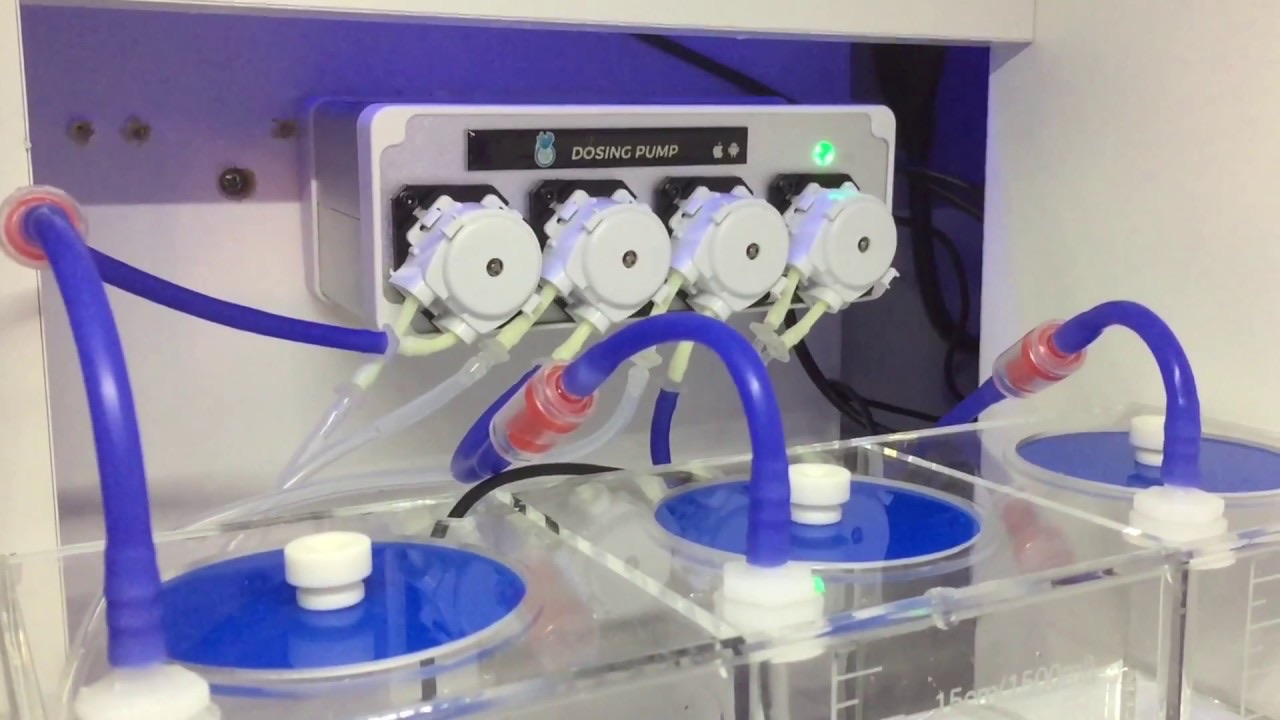
Three containers, three pumps, one tank
- 1KH container food-safe, with its own solution
- 2Calcium container solution kept apart from the others
- 3Magnesium container solution kept apart from the others
- 4Dosing pumps not essential, but they dose on their own
- 5Tank each solution arrives through its own tube
Each element has its own container and its own tube. Once the pumps are calibrated, all you have to do is refill the containers before they run empty.
The values to keep
Before preparing the solutions, you need to check the tank parameters with the test kits mentioned above. Specifically, we recommend keeping the following values:
- KH in a range between 6 and 8 dH° (German degrees)
- Calcium in a range between 400 and 450 mg/l
- Magnesium in a range between 1270 and 1330 mg/l
Preparing and dosing the solutions
Once the Triad has been stabilised using suitable buffers or powdered solutions made for these situations, you can prepare the solutions. We recommend dosing them at different times, to prevent and avoid possible reactions and precipitation.
One solution at a time
- 1All doses at once the solutions meet at the same moment
- 2Reactions, precipitates what you want to prevent
- 3Doses at different times first one solution, then the other
- 4Water without precipitates the goal of this rule
The solutions are dosed at different times, so reactions and precipitation are prevented.
Adjusting the dose
As mentioned above, the amount of solution that makes up for the tank's daily consumption is checked with tests, which are normally carried out at regular intervals of 3 to 7 days, but only for the first period, which is usually between 15 and 30 days. After this trial period, and once the tank has stabilised, checks will be less frequent, and many types of coral in the tank will help us understand whether something is wrong. In any case, you cannot go without checking the parameters for relatively long periods.
The test tells you if the dose is right
- 1The value drops the tank uses more than you dose
- 2The value stays steady the dose makes up for consumption
- 3The value rises you dose more than the tank uses
- 46-8 dH° band the recommended range for KH
- 5The tests every 3-7 days in the first period
An indicative diagram, not real measurements: the same principle applies to calcium and magnesium, each with its own range.
Once the amount consumed has been established, simple calculations tell us the tank's actual needs and on which days to dose the elements. Alternatively, to simplify the process, we recommend dosing pumps: once calibrated, they will make the task easier, and all that will be left for us to do is refill the containers before they run empty.
The method also requires regular water changes of 10% every 15 days or, for the most diligent, 5% every week.
The method, step by step
- 1Measure
Check KH, calcium and magnesium with test kits.
- 2Stabilise
Bring the Triad within its ranges with buffers or powdered solutions.
- 3Prepare
One solution in each container.
- 4Dose
At different times, by hand or with dosing pumps.
- 5Check
Test every 3-7 days for the first 15-30 days.
- 6Adjust
With simple calculations find out what the tank needs and set the dose.
- 7Change the water
10% every 15 days, or 5% every week.
- 8Refill and check
Refill the containers before they run empty; checks become less frequent, but they never stop.
Adding trace elements
With the Balling method, and especially if you use dosing pumps, you can mix into the KH – Calcium – Magnesium solutions the trace elements that the tank will absorb. Here too, almost all the companies that make Balling products sell bottles mixing macro and micro elements useful to corals. Once you are familiar with your tank, it will be easy to work out how much of the trace elements to add. What you have read above is a simple guide to introduce you to the system, which may look complicated to a beginner but, once you get some practice with the tests and the elements involved, turns out to be easy to manage. In any case, for those who want to learn more and for those who are good at DIY, there is a specific and very well made guide that explains how to prepare the solutions for the Triad and the trace elements using pharmaceutical-grade products. This guide is very detailed and precise about doses, and it will certainly help more experienced hobbyists. The author of this excellent work is Salvatore Riccardo, administrator of the BallingMania group, who will be happy to help you with any doubts.
The BallingMania Staff
Sources
- Gómez Batista M. et al. (2020). Intercomparison of four methods to estimate coral calcification under various environmental conditions. Biogeosciences 17: 887-899.
- Murillo L.J., Jokiel P.L., Atkinson M.J. (2014). Alkalinity to calcium flux ratios for corals and coral reef communities: variances between isolated and community conditions. PeerJ 2: e249.
- Sun W., Jayaraman S., Chen W., Persson K.A., Ceder G. (2015). Nucleation of metastable aragonite CaCO3 in seawater. PNAS 112: 3199-3204.
On the same topic
Trace elements and the Balling system
Why two-part dosing makes sodium chloride rise, what solution C of the Balling Method really does, why a water change…
Advanced guide to the Balling method
The follow-up to the basic guide: why sodium and chloride build up, how to prepare the KH, calcium, magnesium and…
Chemistry and biomineralisation
KH, calcium and magnesium are not just numbers to keep stable: they are the bricks, the cement and the additive on…