
Pterois volitans
Red lionfish
The red lionfish, known in Italian as pesce leone orientale 7, belongs to the scorpionfish family (Scorpaenidae). 1 It is recognised by its long venomous dorsal spines, its fan-like pectoral fins and the dark bands on its pale body. 2 3 4 It is native to the Indo-Pacific, but has also become established in the western Atlantic, where it is considered invasive. 4 5
At a glance
Data from the scientific sources listed at the bottom.
Depth in the wild
2–55 m
Size
up to 45.7 cm
maximum total length; Reef Life Survey gives 38 cm
Temperature in the wild
22–28 °C
Where it lives
Its natural range runs from the Cocos-Keeling Islands and Western Australia to the Marquesas and Oeno Island, in the Pitcairn group; to the north it reaches southern Japan and South Korea, to the south Lord Howe, northern New Zealand and the Austral Islands. 2 From the Red Sea to Sumatra it is replaced by the very similar species Pterois miles. 2 4 Outside its natural range it has become established along the Atlantic coast of the United States, in the Caribbean and in the Gulf of Mexico: the most likely route of arrival is the aquarium trade. 4
Conservation
IUCN Red List: least concern (2015). Red List data taken from FishBase and GBIF. 2 8 It does not appear in the CITES lists checked on Species+. 9 A study on imports of marine ornamental fish into the European Union from 2014 to 2021 places it 34th on a list of species to be monitored and cites it as an example of the risk of introducing invasive species. 10
How to recognise it
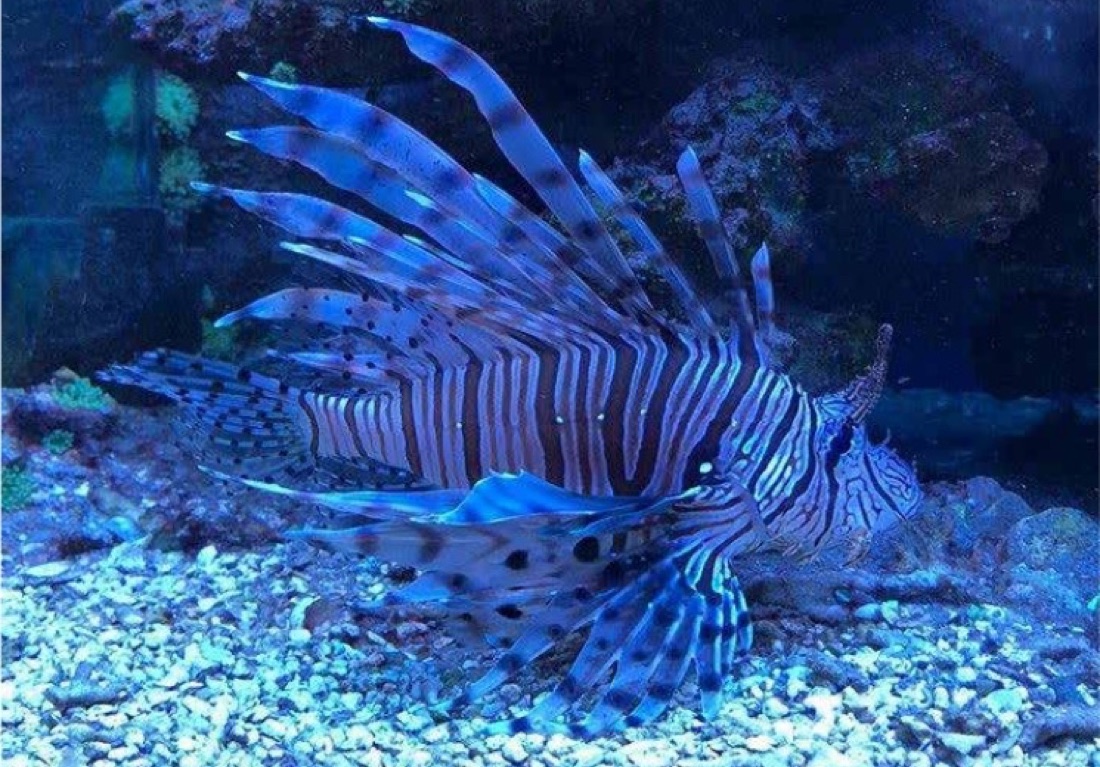
Tap a number on the photo: the key explains what to look for.
- 1Body bands dark on a pale background, broad ones alternating with thin ones; the blue lights distort the colours 3 4
- 2Long dorsal spines greatly elongated, with flag-like membranes; they are venomous 2 3 4
- 3Fan-like pectoral fins long rays joined by flag-like membranes 3
- 4Tentacle above the eye often large, but not always present 2
- 5Spotted fins the fin membranes are often spotted 4
Life in the wild
Where it is found
Lagoons and the outer side of the reef, from turbid coastal waters down to about 50 m. 2 Lionfish use both natural habitats and artificial structures such as wrecks; where they are invasive they are also found on seagrass beds and bridge pilings. 4 For lionfish in general the USGS gives depths of over 300 m, and in Cuba they are documented down to 188 m: these are limits, not the usual habitat. 4 5 In Reef Life Survey counts it was observed in the sea between 18.4 and 31.3 °C. 3
What it eats
A predator: at night it hunts small fish, shrimp and crabs, corners its prey with its pectoral fins spread and swallows it in one go. 2 Studies carried out in the invaded areas show a diet mainly of fish, with crustaceans and other invertebrates such as molluscs and echinoderms; as it grows it eats more fish and fewer crustaceans. 5 The largest can also eat the smallest of the same species. 4
In the aquarium
From the experience of the BallingMania community.
Note: Not compatible with small fish, because they would be eaten
It has always been a fish much appreciated by aquarists for its majestic, imposing and very elegant appearance, as well as for the fascinating predatory instinct that sets it apart.
In the wild it reaches a considerable size, up to 40 cm; in the aquarium too it grows a lot, which is why it is important to have a tank suited to its size; although it is not a great swimmer, preferring to stay sheltered in a crevice or behind a rock, we advise against keeping it in aquariums under 500 litres. As the name suggests, it is a venomous fish: the first rays of the dorsal and anal fins are in fact venomous spines (13 spines on the dorsal fin and 3 on the anal fin), while the rays of the pectoral fins are solid spines and not venomous. Volitans is a born predator, which makes it reluctant to accept dead food straight away during the settling-in phase; it is in fact advisable to offer live food in the first few days. Once the settling-in phase is over it is greedy, with an insatiable appetite, which is why an efficient filtration system is necessary. It is a fish that is very resistant to disease in general, but we advise beginners against it because of the difficulty of settling it in and the danger of its toxin; it should therefore be kept by an experienced and aware aquarist.
photo by: Salvatore Riccardo
Did you know?
Sources
- Froese R., Pauly D. (eds.), via WoRMS (2026). Pterois volitans (Linnaeus, 1758). World Register of Marine Species.
- Froese R., Pauly D. (eds.) (2026). Pterois volitans, Red lionfish. FishBase.
- Reef Life Survey (2026). Pterois volitans, Red firefish. Reef Life Survey.
- U.S. Geological Survey (2026). Pterois volitans/miles: Nonindigenous Aquatic Species Database. USGS.
- del Río L., Navarro-Martínez Z.M., Cobián-Rojas D., Chevalier-Monteagudo P., Angulo-Valdes J.A., Rodriguez-Viera L. (2023). Biology and ecology of the lionfish Pterois volitans/Pterois miles as invasive alien species: a review. PeerJ.
- Rodriguez C., Carrasco J., Bruner-Montero G., Pires Júnior O.R., Gutiérrez M., Díaz-Ferguson E. (2025). Components and Biological Activities of Venom from Lionfishes (Scorpaenidae: Pterois). Marine Drugs.
- GBIF Secretariat (2026). Pterois volitans, nomi comuni. GBIF.
- GBIF Secretariat (2026). Pterois volitans, IUCN Red List category. GBIF.
- UNEP-WCMC (2026). Search for Pterois volitans in the CITES lists. Species+.
- Biondo M.V., Burki R.P., Aguayo F., Calado R. (2024). An Updated Review of the Marine Ornamental Fish Trade in the European Union. Animals.
Sources checked on 5 November 2026. Community texts and ratings are kept separate from the scientific data.