
Tubastrea coccinea
Currently accepted name: Tubastraea coccinea
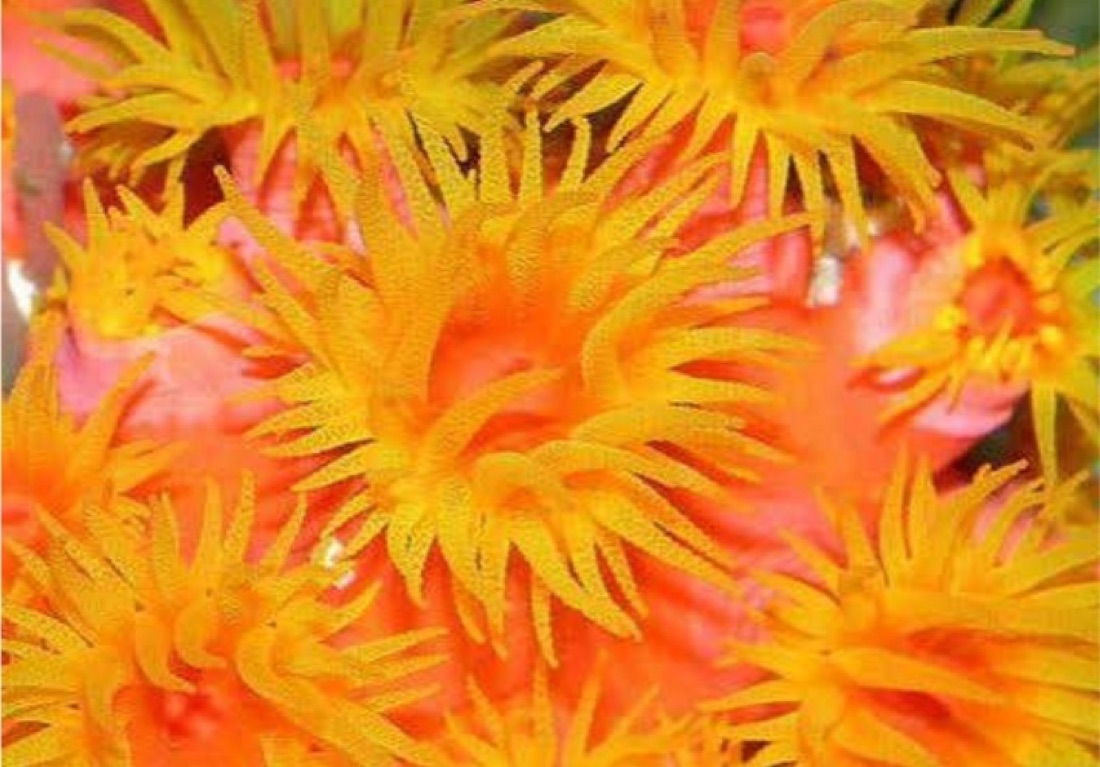
A colonial hard coral with yellow tentacles and orange to pink calices. 2 3 It has no symbiotic algae and lives mainly by catching zooplankton. 7 It is native to the Indo-Pacific and has become invasive in the western Atlantic. 3 5 9
At a glance
Data from the scientific sources listed at the bottom.
Depth in the wild
1–37 m
Size
up to 14 cm
maximum colony diameter; single calices reach 11 mm
Conservation
IUCN Red List: not evaluated. CITES: Appendix II. Red List data taken from SeaLifeBase and GBIF. 2 11 The CITES listing covers all Scleractinia since 18 January 1990, excluding fossils. 10 Where it is introduced it competes with native species and alters food webs. 1 3
Where it lives
The native range given runs from the Red Sea and Madagascar to the tropical coasts of the Americas, from the Gulf of California to Peru; on the Pacific coast of Panama its origin remains uncertain. 3 The type locality is Bora Bora, in French Polynesia. 1 In the Atlantic it is introduced: the first Caribbean record dates from 1943 5 and today it occupies about 9,000 km of western coastline, from Florida to southern Brazil. 5 It is also present in the Gulf of Mexico and, since 2015, in the Canary Islands; its presence in West Africa remains doubtful. 3 Species+ lists more than 60 countries and territories. 10
How to recognise it
Tap a number on the photo: the key explains what to look for.
Life in the wild
Where it is found
It lives in shallow water, under rocky overhangs and, in Hong Kong, in sea caves. 2 In the United States it grows mainly on platforms, wrecks and artificial reefs; in Brazil and the Caribbean it is also common on natural bottoms. 3 The depth range given is 1-37 m 2, but in the Gulf of Mexico it reaches about 50 m 6, off Louisiana it is recorded at 78 m 3 and WoRMS gives 0-110 m. 1 It withstood 15 °C for 96 hours, while at 12.5 °C it dies within 24 hours. 3 In an experiment colonies stopped growing at 16 °C or less. 8
What it eats
It has no zooxanthellae: it depends on catching prey, mostly zooplankton. 7 In its nematocysts 17 probable toxins have been identified, suited to immobilising and digesting prey. 7 In a laboratory study adult colonies were given 50 ml of fresh 50-200 micrometre zooplankton every other day. 4
Reproduction
It broods its larvae and releases them from the mouth. 4 In Brazilian colonies kept in the laboratory for 91 days, 18,139 young were produced; 79% of the larvae emerged with the water at 26 °C, 49% at the first quarter moon and 31% at the new moon. 4 The larvae kept the ability to turn into a polyp for up to 69 days. 4 The sources disagree on its sex: NEMESIS lists it as a hermaphrodite 3, while the Coral Trait Database reports separate sexes from Ayre and Resing (1986). 12 13 Asexual reproduction also matters a great deal: budding, asexual larvae and regeneration from fragments. 3 In Brazilian populations clones are numerous. 5
In the aquarium
From the experience of the BallingMania community.
Tubastrea coccinea, from the Red Sea, the Indo-Pacific and the Caribbean, needs stable values. In the aquarium it should be placed in caves or crevices that shelter it from the light; it is among the most difficult corals to keep, since it is very demanding and needs perfect, constant chemical values; it does not tolerate high nitrate (max 5 mg/l) or the presence of phosphate, and it must also be fed often, even every day, target-feeding each polyp with zooplankton and small live or frozen crustaceans.
Sometimes the polyps close because they are disturbed by passing fish or shrimp.
photo by: Vincenzo Milazzo
Did you know?
Sources
- Hoeksema B.W., Cairns S., Samimi-Namin K. (2026). Tubastraea coccinea Lesson, 1830. World Register of Marine Species.
- SeaLifeBase (2026). Tubastraea coccinea. SeaLifeBase.
- Fofonoff P.W., Ruiz G.M., Steves B., Simkanin C., Carlton J.T. (2018). Tubastraea coccinea, Invasion History (NEMESIS/PanNEMO). Smithsonian Environmental Research Center.
- Luz B.L.P., Di Domenico M., Migotto A.E., Kitahara M.V. (2020). Life-history traits of Tubastraea coccinea: Reproduction, development, and larval competence. Ecology and Evolution.
- Capel K.C.C., Toonen R.J., Rachid C.T.C.C., Creed J.C., Kitahara M.V., Forsman Z., Zilberberg C. (2017). Clone wars: asexual reproduction dominates in the invasive range of Tubastraea spp. in the South-Atlantic Ocean. PeerJ.
- Sammarco P.W., Porter S.A., Genazzio M., Sinclair J. (2015). Success in Competition for Space in Two Invasive Coral Species in the western Atlantic - Tubastraea micranthus and T. coccinea. PLOS ONE.
- Kitahara M.V. et al. (2020). Reciprocal transplantation of the heterotrophic coral Tubastraea coccinea between distinct habitats did not alter its venom toxin composition. Ecology and Evolution.
- Bastos N., Poubel Tunala L., Coutinho R. (2024). Life history strategy of Tubastraea spp. corals in an upwelling area on the Southwest Atlantic. PeerJ.
- Chen X. et al. (2025). High-quality genome assembly of the azooxanthellate coral Tubastraea coccinea (Lesson, 1829). Scientific Data.
- UNEP-WCMC (2026). Tubastraea coccinea, CITES record. Species+.
- GBIF Secretariat (2026). Tubastraea coccinea, IUCN Red List category. GBIF.
- Coral Trait Database (2026). Tubastraea coccinea, Coral Trait Database data. Coral Trait Database.
- Ayre D.J., Resing J.M. (1986). Sexual and asexual production of planulae in reef corals (record in the Coral Trait Database). Marine Biology.
Sources checked on 5 November 2026. Community texts and ratings are kept separate from the scientific data.