
Montipora capitata
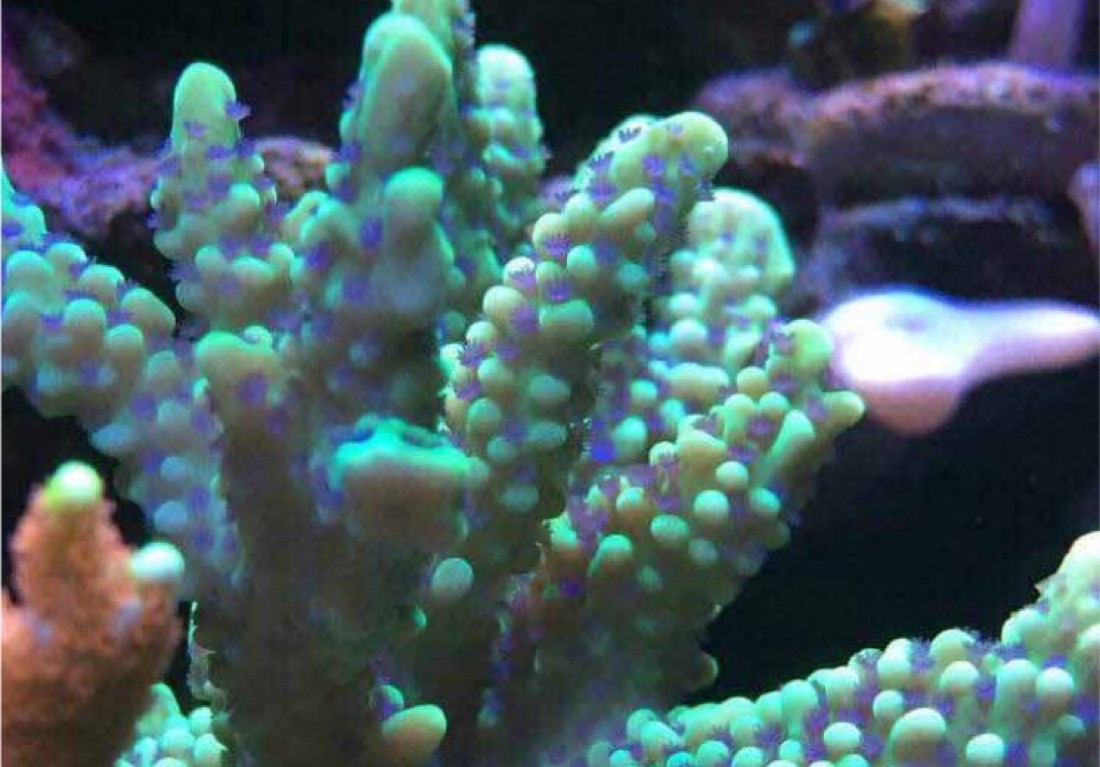
A reef-building hard coral, one of the main ones in Hawaii and among the most abundant in Kāneʻohe Bay. 5 6 The shape of the colony varies enormously, from branches to plates: to identify it, what matters most are the large verrucae, small bumps on the skeleton. 7
At a glance
Data from the scientific sources listed at the bottom.
Depth in the wild
0–20 m
Conservation
IUCN Red List: endangered (2023). CITES: Appendix II. The listed criterion is A3ce. 2 The CITES listing covers the whole order and has been in force since 18 January 1990; in the European Union it is in Annex B. 3 In shallow, brightly lit water, warming threatens its growth more than acidification does. 11
The coral
Group: SPS
Growth form: very variable: thick or thin branches, plates, spirals
Zooxanthellae: yes
Growth: 22.3 mm a year in control colonies at Kāneʻohe and 13.4 mm a year in fragments trampled experimentally (Rodgers et al., 2003). 4 10 Temperature and light are the factors that weigh most on calcification. 11
Where it lives
WoRMS records it in the western and central Pacific. 1 Species+ lists the United States, Japan, the Philippines, Indonesia, Malaysia, Palau, Papua New Guinea, the Solomon Islands, Vanuatu, New Caledonia, Fiji, Tonga and also Mauritius. 3 The field studies cited here almost all concern Hawaii. 5 6 7 Outside the archipelago the boundaries of the species remain unclear: the group's mitochondrial DNA matches that of M. verrucosa and M. danae, and the authors suggest the group also lives elsewhere, without proving it. 7
How to recognise it
Tap a number on the photo: the key explains what to look for.
Life in the wild
Where it is found
Shallow reefs and soft bottoms. 2 The 0-20 m range is the general estimate by Carpenter et al. 12 In Kāneʻohe Bay the colonies studied were on small inner reefs, between less than 1 and 4 m. 5 6 9 One colony was also collected in a turbid, shaded mangrove habitat. 7 Out-of-range values: 46-70 m at Johnston Atoll (Wagner et al., 2014) 4, down to 98 m in SeaLifeBase 2, while for samples at about 60 m the identification as this species is uncertain. 7 During the 2014 warming the water in the bay reached 29-30.5 °C, compared with an average summer maximum of about 28 °C on Oʻahu. 9
What it eats
It hosts symbiotic algae (zooxanthellae). 1 The studies disagree on the role of captured food. According to Grottoli et al. (2006), bleached colonies covered more than 100% of their daily energy needs by eating much more. 8 Wall et al. (2019), after the 2014 bleaching at Kāneʻohe, found no signs of increased feeding in bleached colonies. 9
Reproduction
A hermaphrodite: each colony produces eggs and sperm, released together in small bundles, and fertilisation takes place in the sea. 5 At Kāneʻohe spawning is concentrated in June and July, around the new moon, and begins at about 9 pm; in August there may be a small residual release. 5 In the same study sunlight predicted spawning better than temperature. 5
In the aquarium
From the experience of the BallingMania community.
Montipora capitata is native to the central Pacific Ocean, down to a depth of about 20 metres.
This attractive Montipora is most widespread in the turbulent waters of Hawaii and, specifically, in shallow coral reef habitat.
It is a colonial, encrusting SPS coral with branching and porous forms, with some smooth parts of the coral surface, known as verrucae, from which it gets the nickname of ”rice coral”. Its predominant colour is light brown, with white verrucae, and its polyps are deep purple.
In the aquarium it grows fairly quickly at a temperature in the range 24/27 degrees and salinity 1.024/1.026, with small traces of nitrate and phosphate. In any case, it is strongly recommended to place this coral in an intermediate area of the rockwork, well exposed to the turbulence generated by the circulation pumps.
photo by: Ciro Murino
What studies say about keeping it
Research data only, not advice for a home aquarium. In flow-through mesocosms with sunlight, temperature and light drove growth, and strong light and 2 °C more, together, had a negative effect. 11
Did you know?
Sources
- Hoeksema B.W., Cairns S., Samimi-Namin K. (2026). Montipora capitata (Dana, 1846). World List of Scleractinia, via WoRMS.
- Palomares M.L.D., Pauly D. (eds.) (2026). Montipora capitata. SeaLifeBase.
- UNEP-WCMC (2026). Montipora capitata, CITES listings and distribution. Species+.
- Madin J. et al. (eds.) (2026). Montipora capitata. Coral Trait Database.
- Henley E.M., Quinn M., Bouwmeester J. et al. (2022). Contrasting reproductive strategies of two Hawaiian Montipora corals. Scientific Reports.
- Henley E.M., Quinn M., Bouwmeester J. et al. (2021). Reproductive plasticity of Hawaiian Montipora corals following thermal stress. Scientific Reports.
- Forsman Z.H., Concepcion G.T., Haverkort R.D. et al. (2010). Ecomorph or Endangered Coral? DNA and Microstructure Reveal Hawaiian Species Complexes: Montipora dilatata/flabellata/turgescens & M. patula/verrilli. PLoS ONE.
- Grottoli A.G., Rodrigues L.J., Palardy J.E. (2006). Heterotrophic plasticity and resilience in bleached corals. Nature.
- Wall C.B., Ritson-Williams R., Popp B.N., Gates R.D. (2019). Spatial variation in the biochemical and isotopic composition of corals during bleaching and recovery. Limnology and Oceanography.
- Rodgers K., Cox E., Newtson C. (2003). Effects of mechanical fracturing and experimental trampling on Hawaiian corals. Environmental Management.
- Bahr K.D., Jokiel P.L., Rodgers K.S. (2016). Seasonal and annual calcification rates of the Hawaiian reef coral, Montipora capitata, under present and future climate change scenarios. ICES Journal of Marine Science, summary on OA-ICC.
- Carpenter K.E., Abrar M., Aeby G. et al. (2008). One-third of reef-building corals face elevated extinction risk from climate change and local impacts. Science, reference in the Coral Trait Database.
Sources checked on 5 November 2026. Community texts and ratings are kept separate from the scientific data.