
Caulastrea furcata
Currently accepted name: Caulastraea furcata
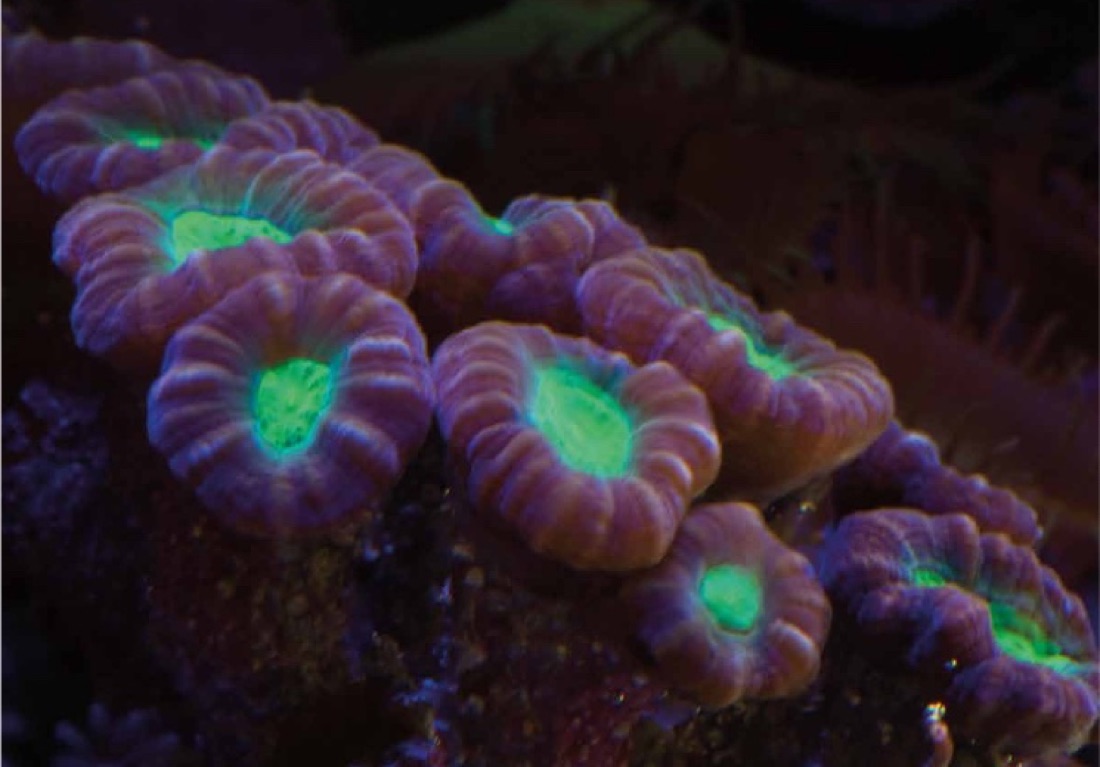
A hard coral with colonies of separate branches and fleshy polyps marked by radiating stripes. 2 It is found from East Africa to Samoa. 2 3 The correct spelling of the name is Caulastraea: 'Caulastrea' is a misspelling recorded by WoRMS. 1
At a glance
Data from the scientific sources listed at the bottom.
Depth in the wild
2–30 m
Conservation
IUCN Red List: least concern (2023). CITES: Appendix II. The CITES listing covers the whole order and has been in force since 18 January 1990; in the European Union it is in Annex B. 3 In Palau no bleaching was observed. 2
The coral
Group: LPS
Growth form: with separate branches (phaceloid), with irregular corallites less than 19 mm across
Zooxanthellae: yes
Where it lives
From Somalia and Madagascar east to Samoa, north to the Ryukyu Islands and south to New Caledonia. 2 Species+ lists, among others, the Seychelles, the Maldives, Indonesia, the Philippines, China, Japan, Palau, Australia, Fiji, Tonga and American Samoa. 3 The original specimen comes from Fiji. 1 In the Seribu Islands, in Indonesia, it is the only species of the genus. 6
How to recognise it
Tap a number on the photo: the key explains what to look for.
Life in the wild
Reproduction
A hermaphrodite: it releases eggs and sperm bundled together, which are let go gently. 2 5 Three colonies from the Palm Islands, in Australia, spawned on 23 November 2021 between 7.50 pm and 8.39 pm. 5 In the Seribu Islands, the ovaries form in the mesenteries, the inner sheets of the polyp, and the study distinguishes four stages of gamete maturation and three of the gonads. 6
In the aquarium
From the experience of the BallingMania community.
Corals of the genus Caulastrea belong to the LPS category (large-polyp corals); they grow fast and can quickly form large colonies; if cared for properly they will keep growing and multiplying, creating new "mouths" through fission, where each polyp develops an extra mouth and then splits in two. They are considered one of the hardiest corals, which makes them particularly suitable even for beginners. They feed at night by extending their tentacles (see the bottom photo) to trap food in the water column. Under actinic lighting (or blue and UV LEDs) these corals take on very bright colours. There are different colour varieties: shocking green, white, pale blue, and red with a green mouth.
Good water quality is essential to keep them, and they need calcium to form and build their structure. Fragging is very simple: just (carefully) snap the branches off at the base.
Species sheet written by: Giuseppe Rogliano · top photo by: Chris Moody - bottom photo by: Teamschreiba
What studies say about keeping it
Research data only, not advice for a home aquarium. In an Australian aquaculture study, colonies collected in the wild were kept in outdoor tanks at about 27.2 °C and spawned in the tanks. The eggs were fertilised in a 60 L aquarium, and the larvae were raised in 70 or 500 L flow-through tanks. 5
Did you know?
Sources
- Hoeksema B.W., Cairns S., Samimi-Namin K. (2026). Caulastraea furcata Dana, 1846. World List of Scleractinia, via WoRMS.
- Palomares M.L.D., Pauly D. (eds.) (2026). Caulastraea furcata. SeaLifeBase.
- UNEP-WCMC (2026). Caulastraea furcata, CITES listings and distribution. Species+.
- Madin J. et al. (eds.) (2026). Caulastraea furcata. Coral Trait Database.
- Abdul Wahab M.A., Ferguson S., Snekkevik V.K. et al. (2023). Hierarchical settlement behaviours of coral larvae to common coralline algae. Scientific Reports.
- Kawaroe M., Soedharma D., Maulinia (2007). The Oogenesis of Sclerectinian Corals Caulastrea furcata and Lobophyllia corymbosa. HAYATI Journal of Biosciences.
- Carpenter K.E., Abrar M., Aeby G. et al. (2008). One-third of reef-building corals face elevated extinction risk from climate change and local impacts. Science, reference in the Coral Trait Database.
- LaJeunesse T.C., Bhagooli R., Hidaka M. et al. (2004). Closely related Symbiodinium spp. differ in relative dominance in coral reef host communities across environmental, latitudinal and biogeographic gradients. Marine Ecology Progress Series, reference in the Coral Trait Database.
Sources checked on 5 November 2026. Community texts and ratings are kept separate from the scientific data.