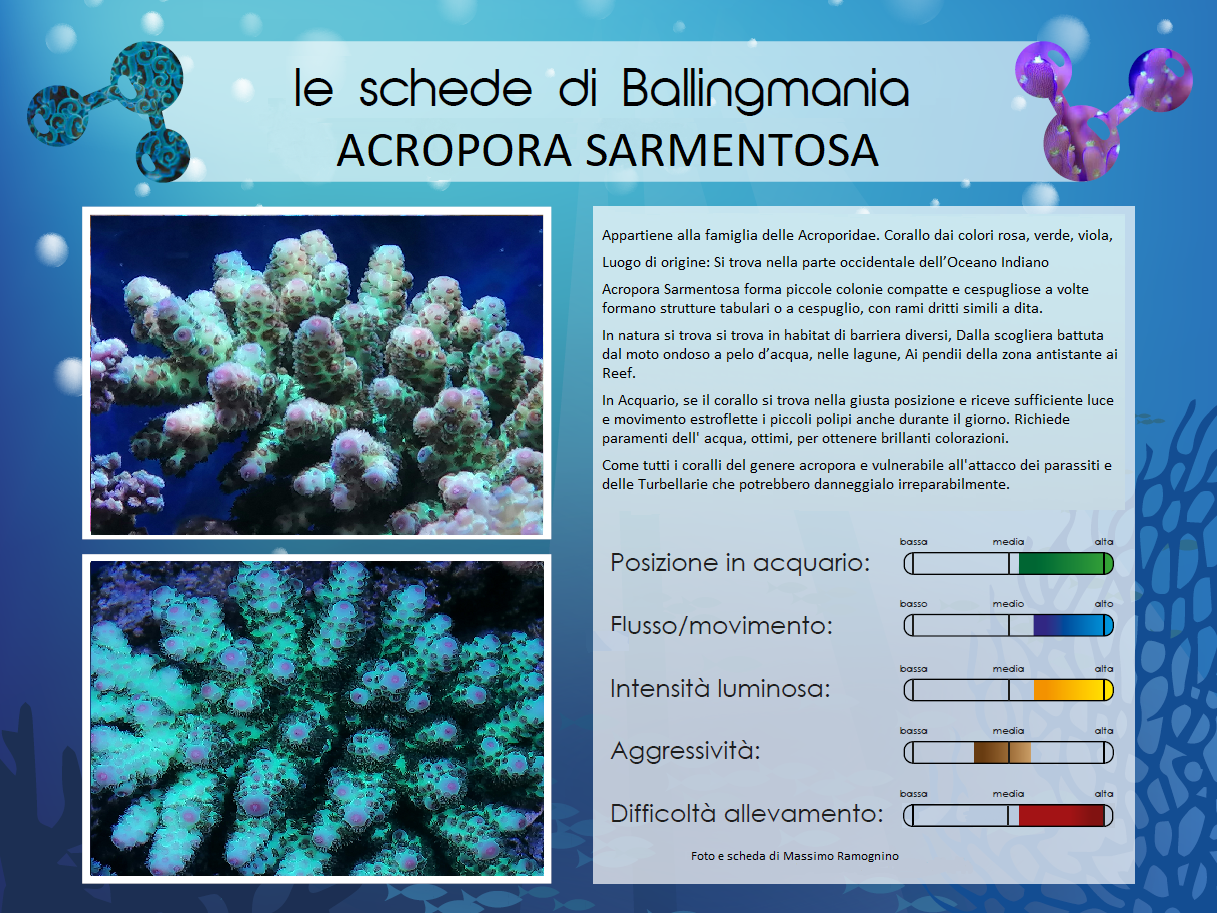
Acropora sarmentosa
A hard coral with corymbose colonies and tubular side corallites pressed against the branch. 9 12 It lives in shallow water, from the eastern edge of the Indian Ocean to the central Pacific. 3 8 It is a hermaphrodite and releases its gametes into the sea. 10
At a glance
Data from the scientific sources listed at the bottom.
Depth in the wild
3–20 m
Conservation
IUCN Red List: endangered (2023). CITES: Appendix II. The listed criterion is A3ce. 3 The CITES listing currently in force dates back to 18 January 1990; in the European Union it is in Annex B. 2
The coral
Group: SPS
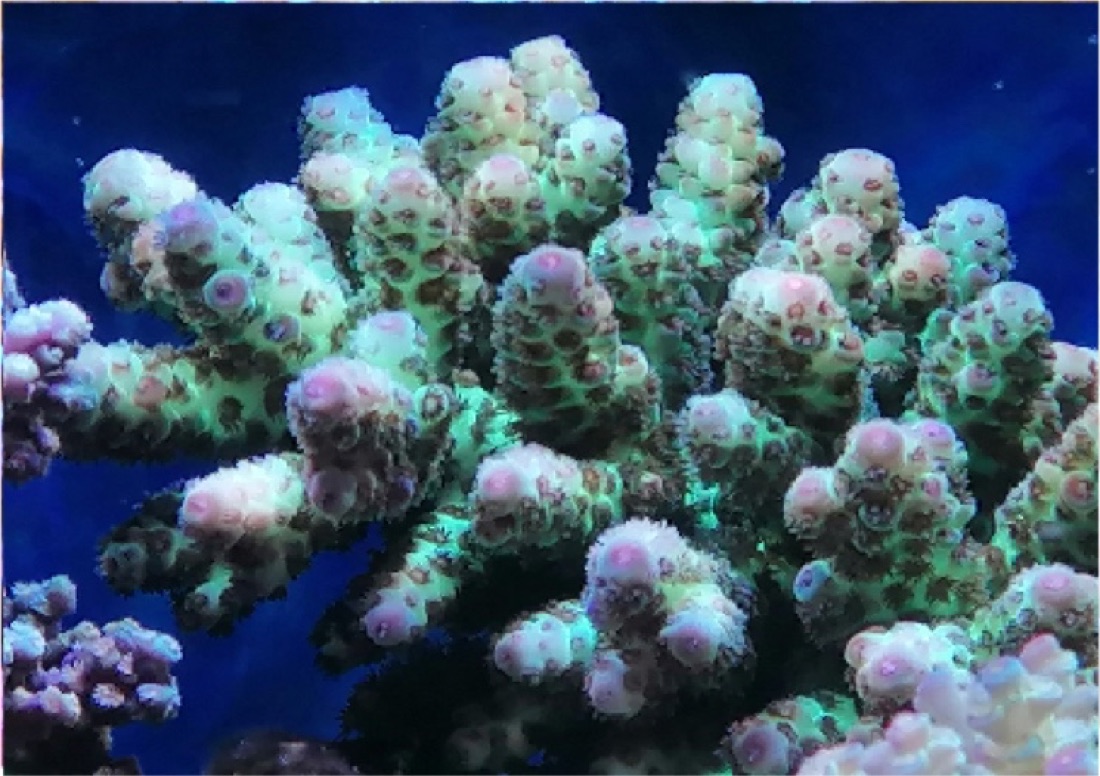
Growth form: corymbose, with corallites 1-2 mm wide 9; the side corallites are tubular and pressed against the branch 12
Zooxanthellae: yes
Where it lives
According to the range dataset of Hughes et al. it runs from about 94° E to about 136° W and from about 28° N to 35° S, covering almost 50 million km². 4 8 WoRMS gives it in the central Indo-Pacific, in Australia and at Kingman Reef. 1 Species+ lists 17 countries and territories, including Indonesia, the Philippines, Japan, Australia, the Cook Islands and French Polynesia. 2
How to recognise it
Tap a number on the photo: the key explains what to look for.
Life in the wild
Where it is found
The usual range is 3-20 m, on permanently submerged reef tops. 3 On the Great Barrier Reef, at Big Broadhurst Reef, it was recorded between 3 and 16 m. 4 7 A 2015 study gives 26 m as the lower limit. 4 6 On the Great Barrier Reef and in the Coral Sea it is common in shallow water and was not found below 30 m. 5
In the aquarium
From the experience of the BallingMania community.
It belongs to the family Acroporidae. A coral in pink, green and purple. Place of origin: it is found in the western part of the Indian Ocean. Acropora sarmentosa forms small, compact, bushy colonies, sometimes forming tabular or bushy structures, with straight, finger-like branches.
In the wild it is found in various reef habitats, from wave-swept reefs at the water's surface, to lagoons, to the slopes of the fore-reef zone.
In the aquarium, if the coral is in the right position and receives enough light and water movement, it extends its small polyps even during the day. It needs excellent water parameters to achieve bright colours.
Like all corals of the genus Acropora it is vulnerable to attack by pests and by flatworms (Turbellaria), which could damage it irreparably.
Photo and species sheet by Massimo Ramognino
Did you know?
Sources
- Hoeksema B.W., Cairns S., Samimi-Namin K. (2026). Acropora sarmentosa (Brook, 1892). World List of Scleractinia, via WoRMS.
- UNEP-WCMC (2026). Acropora sarmentosa, CITES listings and distribution. Species+.
- Palomares M.L.D., Pauly D. (eds.) (2026). Acropora sarmentosa, Blue sarmentosa. SeaLifeBase.
- Madin J. et al. (eds.) (2026). Acropora sarmentosa. Coral Trait Database.
- Muir P., Wallace C., Bridge T.C.L., Bongaerts P. (2015). Diverse Staghorn Coral Fauna on the Mesophotic Reefs of North-East Australia. PLoS ONE.
- Muir P.R., Wallace C.C., Done T., Aguirre J.D. (2015). Limited scope for latitudinal extension of reef corals. Science, reference in the Coral Trait Database.
- Wallace C., Dale M.B. (1978). An Information Analysis Approach to Zonation Patterns of the Coral Genus Acropora on Outer Reef Buttresses. Atoll Research Bulletin, reference in the Coral Trait Database.
- Hughes T.P., Connolly S.R., Keith S.A. (2013). Geographic ranges of reef corals (Cnidaria: Anthozoa: Scleractinia) in the Indo-Pacific. Ecology, reference in the Coral Trait Database.
- Wallace C.C., Done B.J., Muir P.R. (2012). Revision and catalogue of worldwide staghorn corals Acropora and Isopora (Scleractinia: Acroporidae) in the Museum of Tropical Queensland. Memoirs of the Queensland Museum, reference in the Coral Trait Database.
- Willis B.L., Babcock R.C., Harrison P.L., Oliver J.K. (1985). Patterns in the mass spawning of corals on the Great Barrier Reef from 1981 to 1984. Proceedings of the 5th International Coral Reef Congress, reference in the Coral Trait Database.
- LaJeunesse T.C., Bhagooli R., Hidaka M. et al. (2004). Closely related Symbiodinium spp. differ in relative dominance in coral reef host communities across environmental, latitudinal and biogeographic gradients. Marine Ecology Progress Series, reference in the Coral Trait Database.
- Sola E., Silva I.M. da, Glassom D. (2015). An annotated and illustrated checklist of species of the coral genus Acropora (Cnidaria: Scleractinia) from Vamizi Island, Mozambique. African Invertebrates, record on Plazi.
Sources checked on 5 November 2026. Community texts and ratings are kept separate from the scientific data.