
Acanthastrea lordhowensis
Currently accepted name: Micromussa lordhowensis
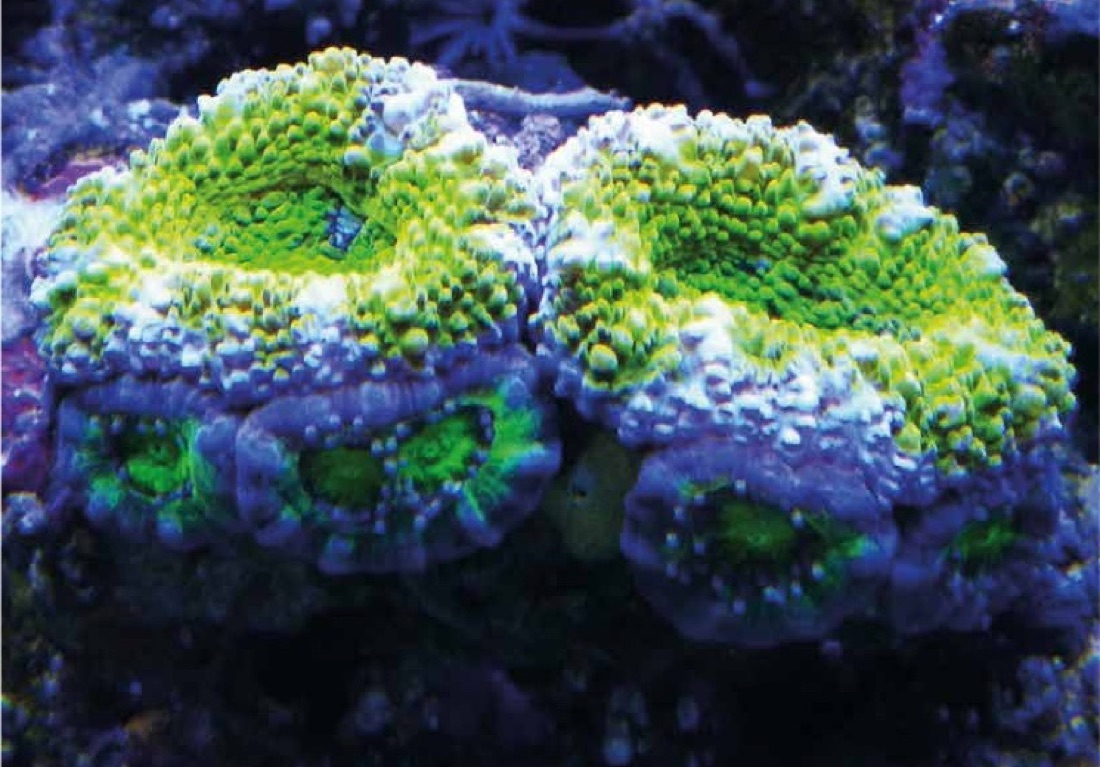
A massive hard coral with large, fleshy polyps, known in the aquarium hobby as Acanthastrea lordhowensis: since 2016 the valid name has been Micromussa lordhowensis. 1 2 It lives in shallow water in the western Pacific, especially in subtropical areas. 5 It is among the corals most collected by the aquarium fishery in Australia. 6
At a glance
Data from the scientific sources listed at the bottom.
Depth in the wild
0–30 m
Conservation
IUCN Red List: endangered (2022). CITES: Appendix II. The listed criterion is A3ce, as reported by WoRMS and SeaLifeBase. 1 4 5 For international trade, the listing currently in force dates back to 18 January 1990; Species+ still lists it as Acanthastrea lordhowensis, and in the European Union it is in Annex B. 3 In Australia it is collected for aquariums, and one study estimated its weight and occurrence to help manage this fishery. 6 An outbreak of two species of crown-of-thorns starfish has hit subtropical corals on Australia's east coast, in communities that also include this species. 7
The coral
Group: LPS
Growth form: massive, with corallites joined by shared walls (cerioid), round or elongated, 8-15 mm
Zooxanthellae: yes
Growth: A study on corals of subtropical areas lists it among long-lived, slow-growing species, and therefore slow to recover from damage. 7
Where it lives
Western Pacific: from Malaysia to Melanesia, north to Japan and south to New South Wales, in Australia. 5 The type locality is Lord Howe Island, and the specimens studied come from Lord Howe, the Solitary Islands and Moreton Bay. 2 The study that moved the species also gives Western Australia and the Coral Triangle, and assigns the old records from the Indian Ocean to a different species, M. indiana. 2
How to recognise it
Tap a number on the photo: the key explains what to look for.
Life in the wild
Where it is found
Shallow water, particularly at subtropical locations. 5 A 2008 dataset gives 1-30 m 8 9; the specimens in the 2016 revision were between 0.5 and 14 m. 2 Like other corals heavily collected for aquariums, it can also live free on soft bottoms between reefs, where it is usually taken from. 6
What it eats
Its family, the Lobophylliidae, is described as made up of species with symbiotic algae (zooxanthellae). 2
Reproduction
A hermaphrodite that releases eggs and sperm into the sea. 9 10 Oocytes reach 400 micrometres at the Solitary Islands. 9 11 In this subtropical community gametes are released from December to April and massive species spawn 8 to 12 nights after the full moon; this applies to the group of corals studied, not just to this species. 10
In the aquarium
From the experience of the BallingMania community.
This is an LPS coral found in the western Pacific and the Indian Ocean, along the African coast, where it populates the shallow reef. The coral, of extraordinary beauty and with varied, breathtaking colours, feeds through its zooxanthellae by day and on zooplankton at night by extending its polyps; what is special about this animal is that the calices are all connected, so it is enough to feed just one of the mouths. Growth is fairly fast, and in the wild reproduction is sexual. It is not a coral suited to beginner aquarists because, although not particularly demanding in terms of nutrient levels in the water, it needs adequate lighting, water movement and stability.
photo by: Antonio Camerlingo
Did you know?
Sources
- Hoeksema B.W., Cairns S., Samimi-Namin K. (2026). Micromussa lordhowensis (Veron & Pichon, 1982). World List of Scleractinia, via WoRMS.
- Arrigoni R., Benzoni F., Huang D. et al. (2016). When forms meet genes: revision of the scleractinian genera Micromussa and Homophyllia (Lobophylliidae) with a description of two new species and one new genus. Contributions to Zoology, archivio Naturalis.
- UNEP-WCMC (2026). Acanthastrea lordhowensis, CITES listings and distribution. Species+.
- GBIF Secretariat (2026). Micromussa lordhowensis on the IUCN Red List (Huang et al.), data from GBIF. GBIF.
- Palomares M.L.D., Pauly D. (eds.) (2026). Micromussa lordhowensis. SeaLifeBase.
- Pacey K.I., Caballes C.F., Pratchett M.S. (2023). Using size-weight relationships to estimate biomass of heavily targeted aquarium corals by Australia's coral harvest fisheries. Scientific Reports.
- Sommer B., Malcolm H.A., Cooney C. et al. (2025). Understanding and managing species range shifts: first observed mixed-species outbreak and coral predation by crown-of-thorns starfish on subtropical reefs. Marine Environmental Research.
- Carpenter K.E., Abrar M., Aeby G. et al. (2008). One-third of reef-building corals face elevated extinction risk from climate change and local impacts. Science.
- Madin J. et al. (eds.) (2026). Micromussa lordhowensis. Coral Trait Database.
- Wilson J.R., Harrison P.L. (2003). Spawning patterns of scleractinian corals at the Solitary Islands: a high latitude coral community in eastern Australia. Marine Ecology Progress Series.
- Wilson J.R., Harrison P.L. (1998). Settlement-competency periods of larvae of three species of scleractinian corals. Marine Biology, reference in the Coral Trait Database.
- Baird A.H., Bridge T., Quigley K.M. et al. (2026). The chromosomal genome sequence of the starry cup coral, Micromussa lordhowensis (Veron & Pichon, 1982) and its associated microbial metagenome sequences. Wellcome Open Research, via Europe PMC.
Sources checked on 5 November 2026. Community texts and ratings are kept separate from the scientific data.