
Using turf algae in modern ATS (Algae Turf Scrubber) filters
A carpet of algae that works for the tank and carries the nutrients away
Given that reefs host many forms of biodiversity, in our aquariums we must try to reproduce that biodiversity to get a stable, balanced tank. Unfortunately, for reasons of space and volume, it is not possible to recreate in the aquarium all the habitats that Mother Nature has created at the various levels and depths of the sea. As is well known, reefs are home not only to corals but also to a great quantity of algae, fed by nutrients and by the organic load produced by fish, as well as by discharges from human settlements. So the ATS turf scrubber plays a key role because, at least in part, it imitates the processes driven by the algae on rocky substrates and on the semi-exposed parts of the coral reef.
The algal carpet
Note that these algae grow as turf-like carpets, with bush-shaped filaments. These turf carpets are made up of many species of algal filaments, upright and packed closely together, of limited height, generally reaching only a few millimetres, which can hold on to a great deal of sediment and zooplankton.
What turf algae are like
- 1Algal filaments upright and packed, many species
- 2Sediment trapped among the filaments
- 3Zooplankton held by the carpet
- 4Rocky substrate the carpet grows on it
A short, dense carpet: the filaments hold on to sediment and zooplankton.
Sources: [2]
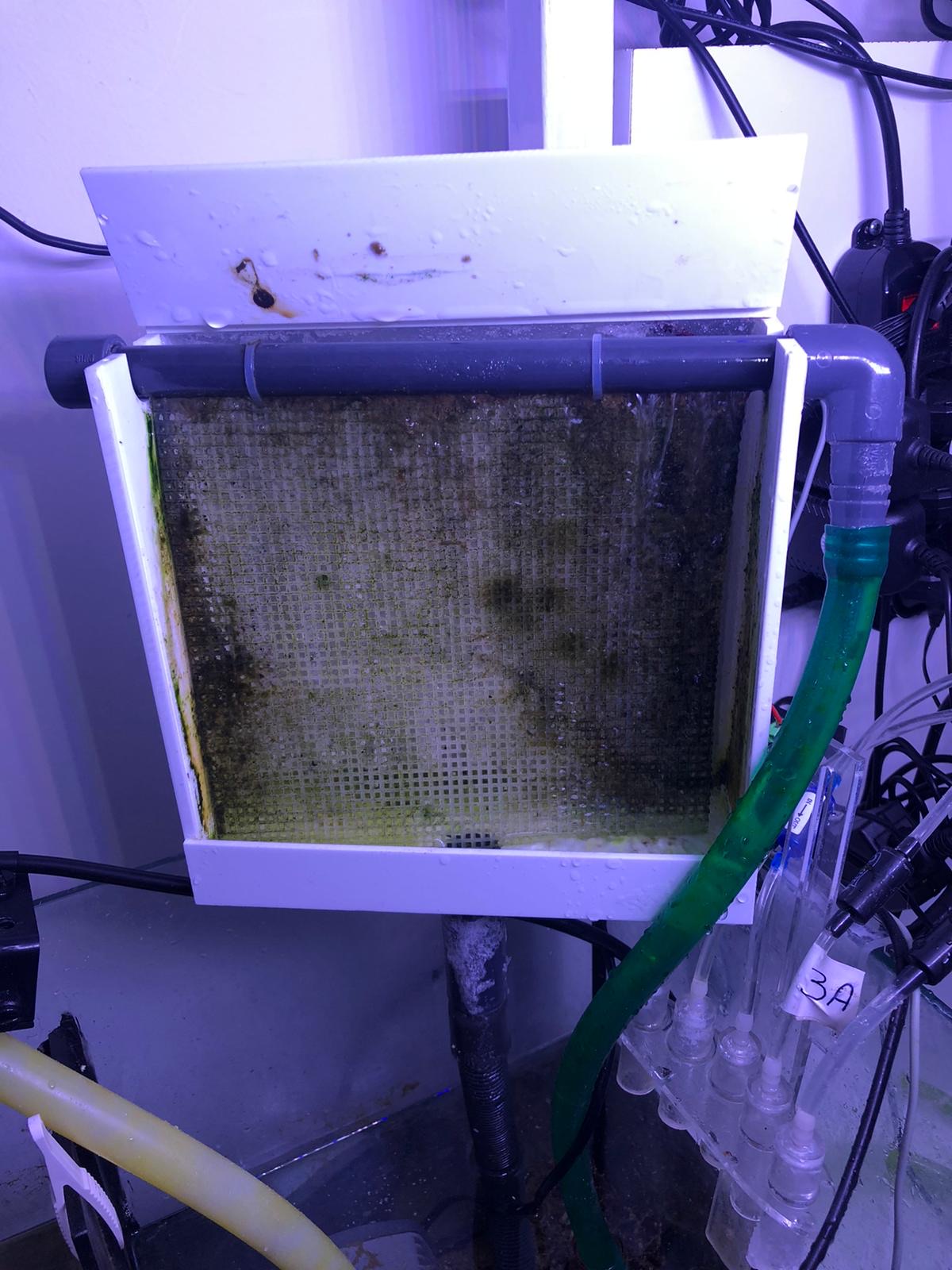
The ATS filter
Earlier scientific studies have shown that the ATS filter can take up considerable amounts of nitrogen and phosphorus. In 1970 Dr Walter Adey put into practice this system of taking up nutrients with algae, commonly called turf.
Algae growing inside modern ATS filters imitate some of the processes that happen in nature, with water flowing over special semi-submerged supports lit with a suitable colour temperature.
How water flows in an ATS
- 1Water pipe water arrives and flows over the support
- 2Grid support semi-submerged, holds the carpet
- 3Algal carpet takes up nutrients
- 4Light with a suitable colour temperature
- 5Drain the water goes back down
- 6Pump brings the water back up
Water flows over the lit grid: here the algae take up the nutrients.
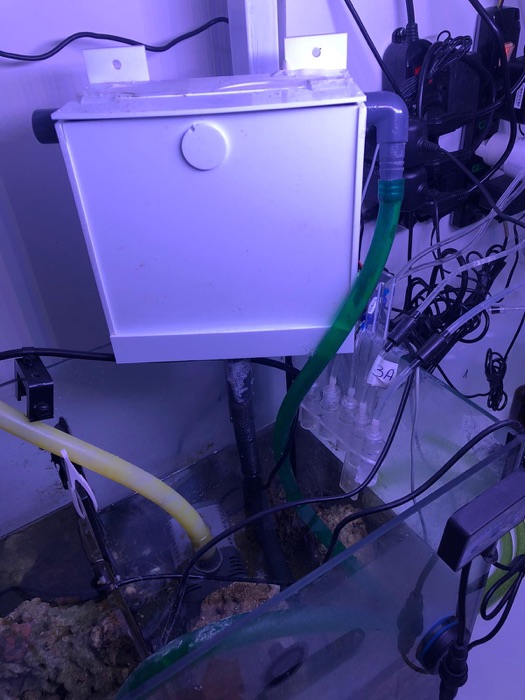
Harvesting
Of course, the algal carpet that forms on the support (in the filter inside the ATS) must be removed periodically, and with it the nutrients these algae have taken up.
In the tank
From what I have heard from American reefkeepers I know, it seems that this filtration system manages to keep dissolved nutrients at suitable levels in the tank. Nuisance macroalgae do not spread in the tank, and zooplankton thrives on the ATS support.
The light
Lighting the ATS filter at night is strongly recommended, because this way it is possible to keep the oxygen level and pH within the ideal ranges.
The filter on while the tank is dark
- 1Tank, by day the main light is on
- 2ATS, by day lamp off
- 3Tank, at night the main light is off
- 4ATS, at night on: oxygen and pH in range
This is the authors' advice. In an ATS the carpet produces oxygen and raises pH 3, but we found no studies on this practice in reef aquariums.
Sources: [3]
Of course, the stronger the light and the more hours it is on (in the range of wavelengths suited to algae), the more the algal carpet will grow on the ATS support.
From light to nutrients carried away
Removing the carpet also removes the nutrients it has taken up.
Sources: [1]
It has also been found that using this filter reduces the workload of the skimmer and of any mechanical filtration.
Article written by: Ciro Murino and Marco Mura
Sources
- Adey W.H., Kangas P.C., Mulbry W. (2011). Algal Turf Scrubbing: Cleaning Surface Waters with Solar Energy while Producing a Biofuel. BioScience 61(6): 434-441.
- Tebbett S.B., Bellwood D.R. (2019). Algal turf sediments on coral reefs: what's known and what's next. Marine Pollution Bulletin 149: 110542.
- Adey W.H., Smithsonian Institution (1982). Algal turf scrubber, US patent 4,333,263. United States Patent and Trademark Office.
On the same topic
Snow in the tank: four clarifiers compared
ATI Easyvital, KZ Coral Snow, Modern Reef BIOReef-Snow and Resolve look alike, but they work in different ways:…
Bacterial growth: what really happens
"We dose bacteria to lower nitrates and phosphates" is only the end result, not the process. What really happens in…
The refugium: the biological lung of the reef
The skimmer removes organics before they become nitrate; the refugium absorbs what has already formed. How it works,…
Comments (4, in Italian)
Bel articolo chiaro e scritto bene....averlo avuto quando ho iniziato!!
Grazie
Dopo quanto tempo va pulita la rete dalle alghe. E la luce solo nel periodo notturno ma con quanti vat. E che dimensioni dovrebbe essere un filtro ATS al suo interno cioè la rete che dimensione deve avere io presempio ho un acquario da 90x60x60. Grazie
Ciao per avere una risposta iscriviti sul canale facebook
e poni la domanda.