
The importance of the protein skimmer
How it is made, how it works, how to adjust it and how to keep it clean
Until the 1990s the skimmer was used very little: everything was left to the biological filter, which we now snub. The need was felt to bring security to our system, since running a tank with a biological filter was very unstable, with swings in values and sudden growth of algae colonies.
A bit of chemistry
One very important thing that helps you understand how the skimmer works and how to use it is the nitrogen cycle, or rather the cycle of nitrogen compounds (ammonia, nitrite and nitrate).
The nitrogen cycle starts from organic substances introduced into the aquarium (e.g. food), which through oxidation, or the so-called Krebs cycle, lead to the formation of proteins (NH). Some of the proteins will help the tank and the animals with their own needs, while the deamination of another part of the proteins will produce amine residues, namely ammonia, which is toxic for the tank.
This ammonia of biological origin must be disposed of by oxidation, thanks to the work of the bacterial colonies formed in the porous areas of our aquarium. This oxidation process takes place in 2 steps:
- The first process is carried out by Nitrosomonas, namely nitrosation, where these bacteria turn ammonia (NH3) into nitrites (NO2).
- The second process is carried out by Nitrobacter, in which the nitrites formed earlier are oxidised into nitrates (NO3).
So without skimmate, and therefore without exporting proteins, we would get a build-up of NO3 that would lead to algae appearing, unwanted in our aquarium.
From food to nitrates, and where the skimmer comes in
- 1Food organic substances entering the tank
- 2Proteins some are used by the animals
- 3Ammonia (NH3) toxic, comes from deamination
- 4Nitrites (NO2) made by Nitrosomonas
- 5Nitrates (NO3) made by Nitrobacter
- 6Algae appear if nitrates build up
- 7Skimmer exports proteins
Without exporting proteins, nitrogen goes all the way to nitrates and algae.
How is a skimmer made?
The skimmer is basically made up of three parts:
- Contact column, where water and air are mixed.
- Neck, up which the foam rises before settling in the cup.
- The skimmer pump: made up of an impeller and a venturi, which help mix water and air.
How a skimmer is made
- 1Contact column water and air mix here
- 2Neck the foam rises up the neck
- 3Cup collects the dark liquid
- 4Pump with impeller helps mix water and air
- 5Venturi part of the skimmer pump
- 6Air tube must be kept clean
Three parts working together: pump, column and neck, plus the cup that collects.
How it works
Proteins, lipids and so on have a hydrophobic part and a hydrophilic part. When air is mixed into the water in the form of tiny bubbles, these molecules (which are dissolved in the water) line up along the outer surface of the air bubbles, with the hydrophobic part facing the air bubbles and the hydrophilic part facing the opposite way.
At this point the bubbles rise up the contact column and into the neck, where they form a dense foam, and then end up in the skimmer cup, where it collects as a dark, thick, smelly liquid loaded with waste substances and bacteria living suspended in the water, with the resulting removal of proteins.
How air carries away organic substances
- 1Air bubble tiny, rises up the column
- 2Hydrophobic part facing the bubble
- 3Hydrophilic part facing the opposite way
- 4Dissolved molecules proteins, lipids and the like
- 5Dense foam rises up the neck, then into the cup
The molecules settle on the surface of the bubbles and rise with them to the cup.
Adjustments we can make to the skimmer
Another very important thing for getting the right skimming is how to adjust a skimmer. I recommend always keeping the air fully open for better mixing, and playing only with the water inlet into the skimmer's contact chamber.
In our jargon we often talk about "dry" or "wet" skimming.
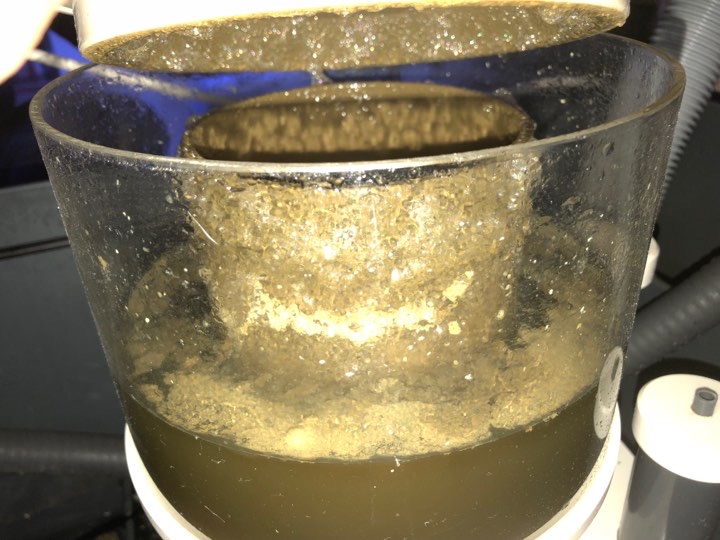
- Dry: this happens when the level in the skimmer's contact chamber is very low, so before overflowing into the cup the foam dries too much, giving a lot of thick sludge both in the neck and inside the cup; it is often used on very lean tanks, with slower removal of organics as a result.
- Wet: this happens when the level in the skimmer's contact chamber is very high, so that the foam does not dry too much and overflows sooner into the cup; this setting is often used for tanks with a high organic load.
This does not mean that the wet setting removes more organics than the dry one, only that it removes them faster.
Dry and wet skimming
- 1Low level the foam dries too much
- 2Thick sludge in the neck and inside the cup
- 3High level the foam doesn't dry too much
- 4Overflows sooner reaches the cup early
Wet skimming doesn't remove more organics: it just removes them faster.
Skimmer maintenance
To always get the best performance from your skimmer, it needs constant maintenance:
Maintenance at a glance
| What | When | How |
|---|---|---|
| Cup | Every week | Brush or sponge for the sludge |
| Air tube | Every week | 5 ml of warm RO water with a syringe |
| Skimmer pump | At least every 6 months | Taken apart, in muriatic acid diluted to 10% with water |
Weekly cleaning of the cup
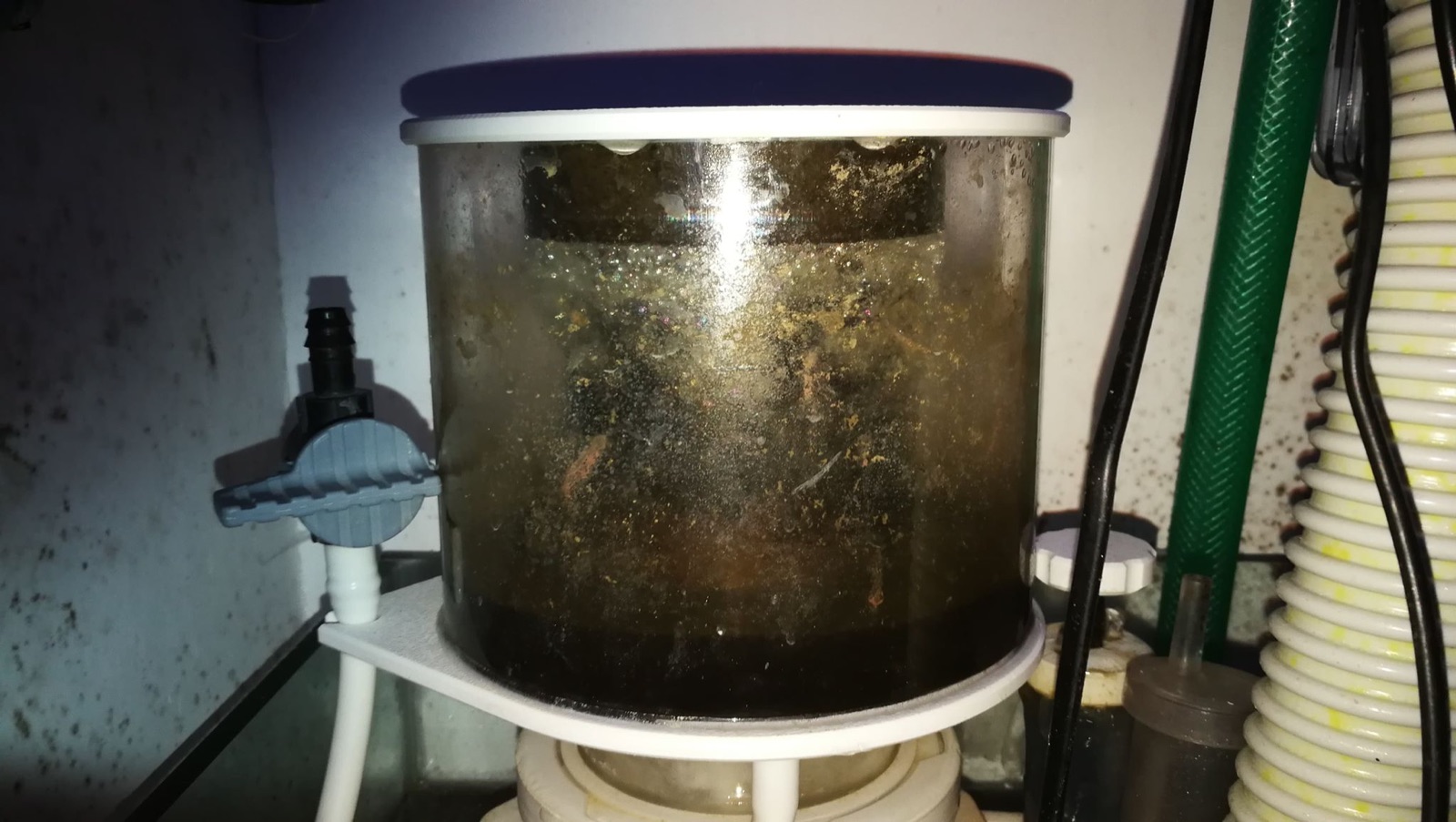
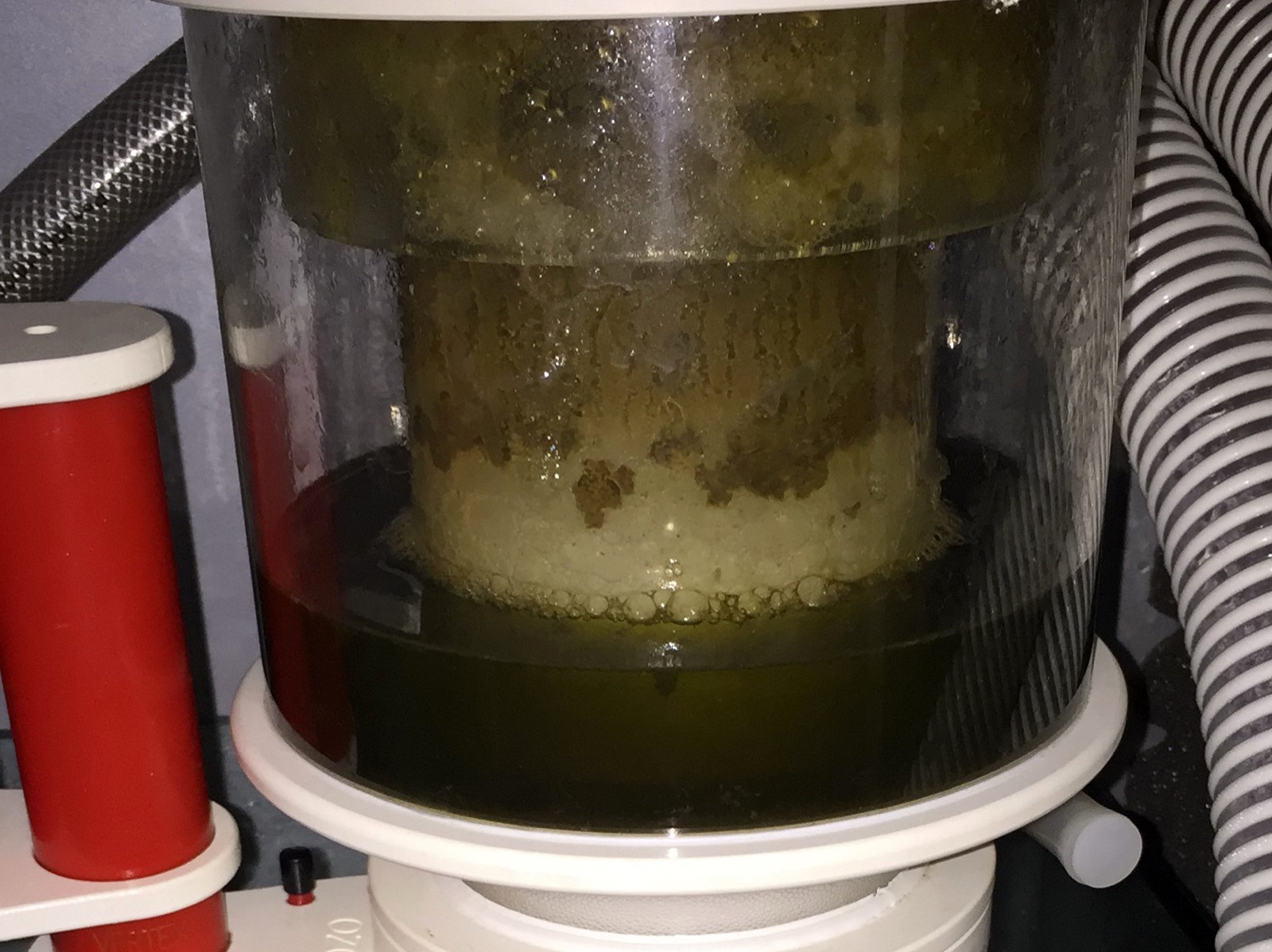
After a week of dirty work the cup will have filled with a brown, smelly liquid, and on the last few centimetres of its neck an equal amount of sludge will form, which must be removed with a brush or a sponge.
Cleaning the skimmer pump
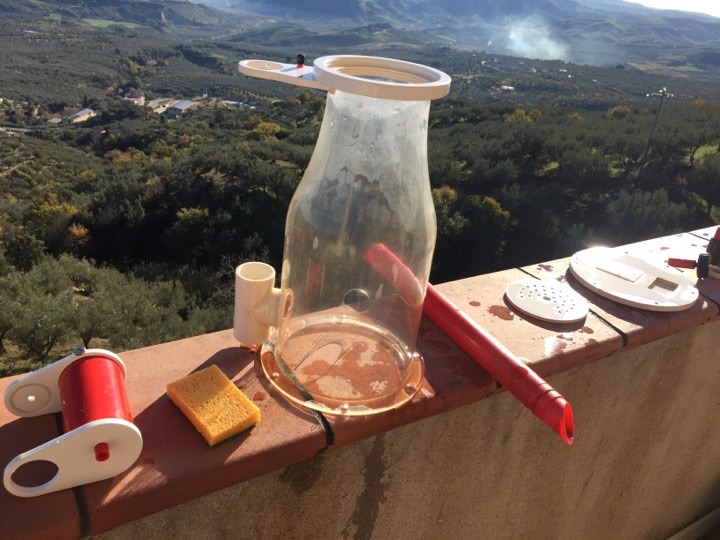
On the whole this kind of maintenance does not need constant cleaning. I recommend cleaning it at least every 6 months, taking apart the pump and its components (cover, impeller etc.) and soaking them in a solution of muriatic acid diluted to 10% with water, which is often used to clean other aquarium components too.
Cleaning the air injector
Cleaning the so-called "air tube" is very important: this vital component of the skimmer often gets clogged with calcium and salt residue. So it is a good habit to inject 5 ml of warm RO water into the tube with a syringe, so as to dissolve the residue left in it. For the skimmer to work properly, it is a good habit to repeat this procedure every week.
I hope you enjoyed it, kind regards.
author: Antonio Capasso
Sources
- Sochacki M., Michorczyk P., Vogt O. (2025). Foam Fractionation as an Efficient Method for the Separation and Recovery of Surfactants and Surface-Inactive Agents: State of the Art. ACS Omega 10(1): 55-75.
- Barrut B., Blancheton J.-P., Callier M., Champagne J.-Y., Grasmick A. (2013). Foam fractionation efficiency of a vacuum airlift: Application to particulate matter removal in recirculating systems. Aquacultural Engineering 54: 16-21.
- Brambilla F., Antonini M., Ceccuzzi P., Terova G., Saroglia M. (2008). Foam fractionation efficiency in particulate matter and heterotrophic bacteria removal from a recirculating sea bass (Dicentrarchus labrax) system. Aquacultural Engineering.
- Foesel BU et al. (2008). Nitrosomonas Nm143-like ammonia oxidizers and Nitrospira marina-like nitrite oxidizers dominate the nitrifier community in a marine aquaculture biofilm. FEMS Microbiology Ecology.
- NIOSH (2019). Pocket Guide to Chemical Hazards: Hydrogen chloride. Centers for Disease Control and Prevention.
- NIOSH (2014). NIOSH Manual of Analytical Methods, method 7907. Centers for Disease Control and Prevention.
On the same topic
Snow in the tank: four clarifiers compared
ATI Easyvital, KZ Coral Snow, Modern Reef BIOReef-Snow and Resolve look alike, but they work in different ways:…
Bacterial growth: what really happens
"We dose bacteria to lower nitrates and phosphates" is only the end result, not the process. What really happens in…
The refugium: the biological lung of the reef
The skimmer removes organics before they become nitrate; the refugium absorbs what has already formed. How it works,…
Comments (1, in Italian)
Ottimo articolo! Grazie.