
RTN, STN and coral bleaching
Rapid necrosis, slow necrosis and loss of zooxanthellae: how to recognise them, where they come from, how to act
One of the most common problems many reef enthusiasts run into when managing their tank is rapid tissue necrosis, RTN; slow tissue necrosis, STN; and coral bleaching. These phenomena are generally seen on SPS corals (Small Polyp Stony), the most susceptible being also the most delicate, such as the genera Acropora, Pocillopora and Stylophora; they are less frequent on the genus Montipora, which is the hardiest of those mentioned. Although LPS corals (Large Polyp Stony) are hardier, the phenomenon can be seen on them too, and the causes can still be traced back to common factors.
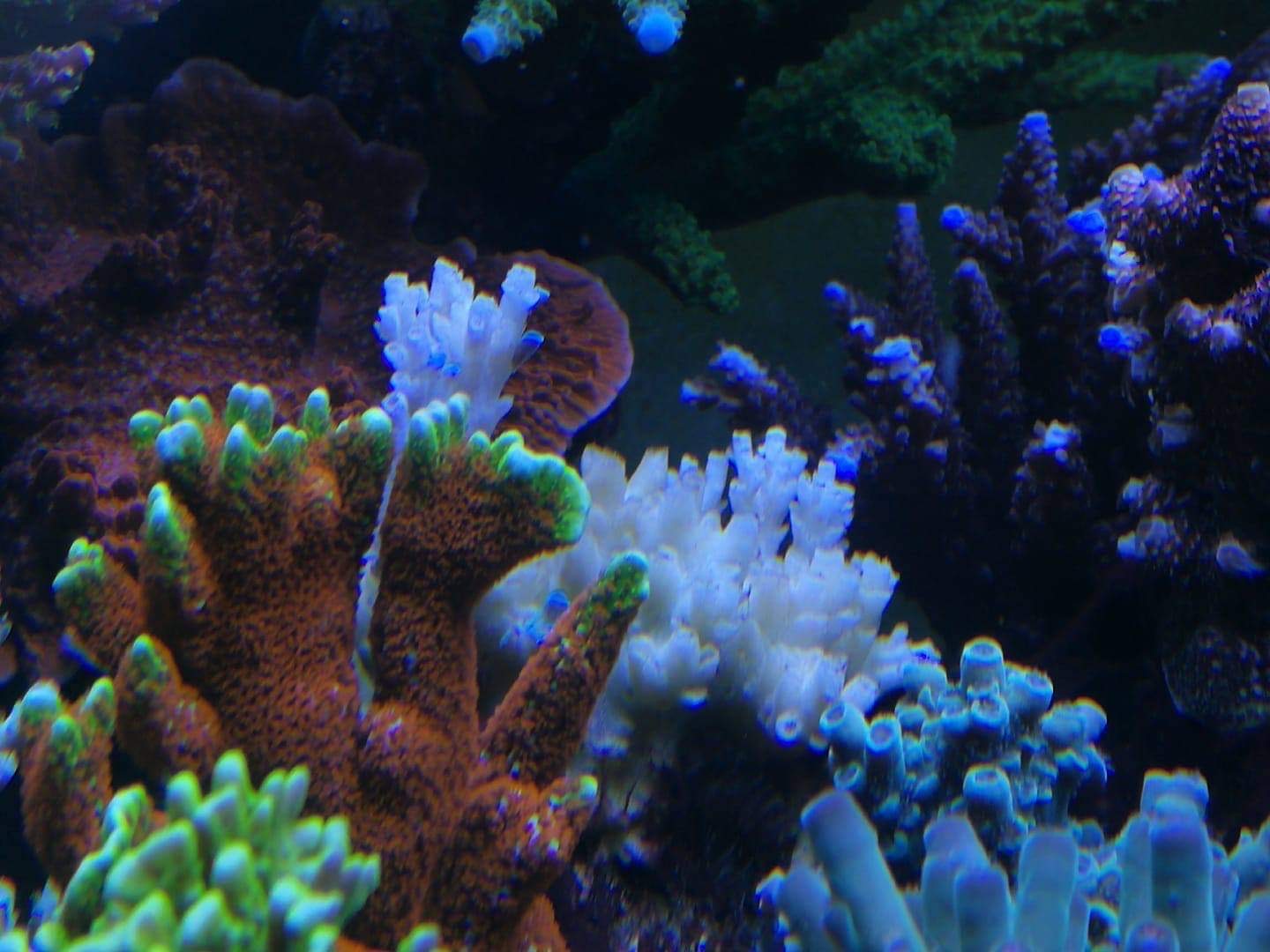
RTN and STN
RTN (Rapid Tissue Necrosis) is when the coral's connective tissue comes away from its limestone skeleton in strips. Once it has started, this necrosis progresses very fast: a large colony can lose all its tissue in less than 24 hours, leading to the animal's death.
STN (Slow Tissue Necrosis) happens much more slowly than RTN: it shows in the same way but over decidedly longer times, and the coral's death could come after weeks or even months. In this case the animal's tissue is not lost in strips; instead you see a slow but steady regression of the tissue, leaving the animal with a white, dead limestone skeleton.
RTN and STN on the same branch
- 1Strips of tissue in RTN they come off the skeleton
- 2Bare skeleton stays white where the tissue has gone
- 3Receding edge in STN the tissue slowly regresses
- 4Dead skeleton white, starts at the branch base
- 5Young branches here the tissue lasts longer
They show in the same way, but RTN runs in hours and STN takes weeks or months.

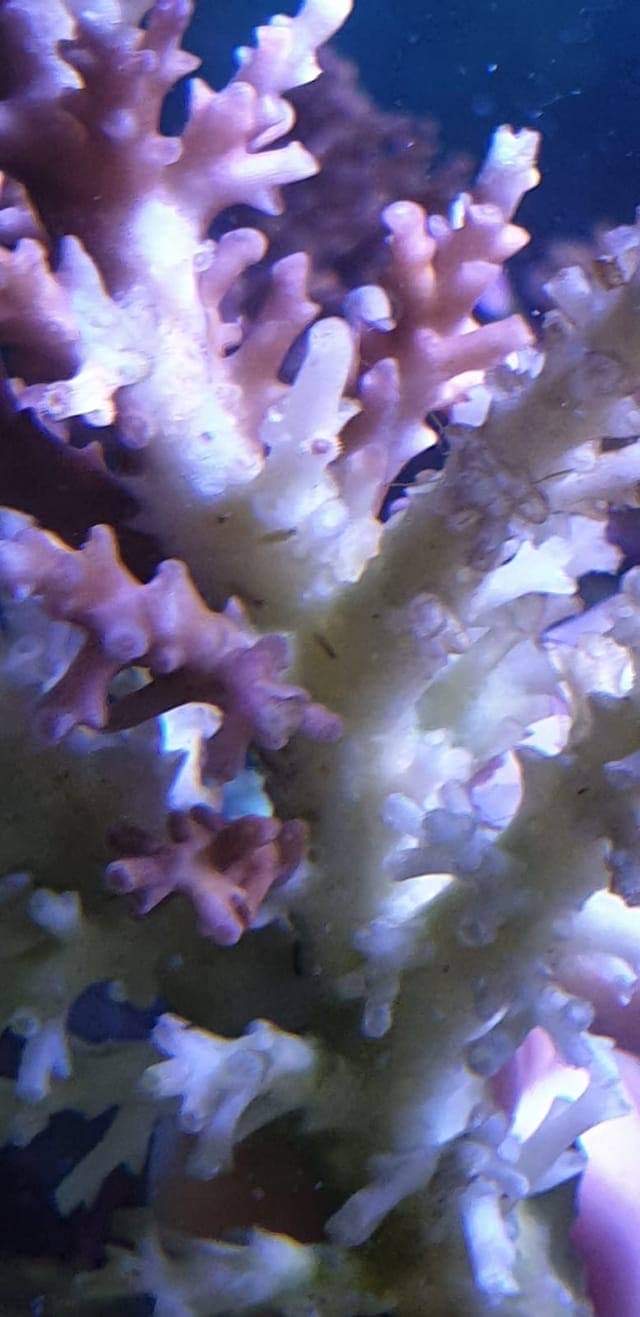
(Corals hit by RTN; photos by Jacopo Di Muro and Gian Snow)
Why tissue necrosis happens
Both RTN and STN in corals are caused by an infection of the coral's tissue and skeleton by microscopic protozoa classed as parasites. These protozoa are a family of single-celled organisms visible only under the microscope; they are present in the water column and inside the coral's tissue and skeleton. In 2018 Dr Ara Deukmedjian carried out a series of experiments showing that these protozoa are the cause of RTN and STN in corals: the experiments aimed to culture the protozoa and infect healthy coral samples with them, and the result led to the conclusion that in every case the coral attacked by the protozoa always developed the disease, RTN or STN, with the resulting necrosis and death.
Although there are many variables that can cause necrosis and stress the coral, we will try to cover the most common factors.
The four most common causes, inside the tank
- 1Alkalinity swing new corals, salt change, hand dosing
- 2Salinity changes water evaporates, salt doesn't
- 3Temperature swings rises with the lights, falls at night
- 4Too little food a tank that is too lean favours STN
There is one common thread: stability. Every sudden change is a stress for the coral.
Alkalinity swing
An alkalinity (KH) swing can happen in a few situations brought about by the aquarist:
1) Adding a new coral to the tank
Wild, farmed or imported corals are vulnerable to alkalinity fluctuations because of the long hours of transport to reach the import centres. There, acclimatisation is not always done properly, and later on, even in shops, you very often see very stressed, colourless and very faded corals for sale. For this reason new corals need a careful acclimatisation period before going into the tank. This acclimatisation should be done very gradually, to get the animal used to the new alkalinity values; preferably it should be done drop by drop over a period of a few hours. After going into the tank our coral should be placed in an area with gentle but alternating flow and light exposure that is as indirect as possible. These conditions should be kept until, looking at the coral, you see an overall state of health from its polyp extension and the thickness of its tissue: visually, it should have fleshy, coloured tissue.
2) Changing the salt used for water changes
Different brands of salt can have alkalinity differing by several points, and this can change the alkalinity of the system. It is very important to know the KH level of the salt you use and to adjust it to the tank's value.
3) Manual dosing
For this reason it is best to check regularly and make sure alkalinity is stable, with very few fluctuations. Manual dosing requires constant testing and can create very irregular KH levels, so the best way to supplement is to use a dosing pump. These pumps ensure the right amount of supplement every day to keep the KH level constant. It is important to note, however, that even with very precise dosing pumps you still need to check alkalinity regularly: as the corals grow, consumption grows in proportion; testing and ensuring stable alkalinity will help eliminate any chance of necrosis following sudden changes.

(Coral hit by STN; photo by Matteo Zucco)
Salinity changes
Another cause of tissue necrosis is a sudden, abrupt change in salinity. Salinity is undoubtedly the best-known characteristic of seawater and also one of those that most affect the life of organisms. In nature it averages 35‰, that is 35 g of salt per 1 kg of water, but in enclosed or semi-enclosed seas, where evaporation exceeds the input of fresh water from rivers and rainfall, the salts become concentrated and salinity rises. This is the case, for example, of the Red Sea, where the arid climate of the surrounding areas and the lack of rivers lead to an average salinity of 42‰.
In our tanks this can happen when water changes are done without first checking the correct salinity. A refractometer is the best and most accurate way to check the proportion of dissolved salts. Since all aquariums are subject to evaporation, the water must be topped up. While water evaporates, salt does not, so salinity will rise as the volume of water falls through evaporation.
Recently, with our aquariums run on various Balling systems, we have noticed slight, slow changes. In this case too, water must be removed from the tank and replaced with the same amount of RO water.
Temperature swings
A fundamental requirement for our reef aquariums is stability, and this factor is essential for temperature too. In tanks with relatively small volumes of water and lighting such as fluorescent tubes or metal halides, the temperature can rise sharply during the lighting cycle and cool at night while the lights are off; combined with the temperatures of the changing seasons, this means our tank's temperature fluctuates continuously. To avoid this problem we must plan, depending on the type of lighting and room conditions, for a climate control system, adding suitable heaters and chillers, available on the market.
Feeding
One of the main ways to prevent STN is to feed our corals correctly. In nature corals have developed various feeding strategies to increase their survival in nutrient-poor waters, called "autotrophic", direct, and "heterotrophic" predation. Thanks to the symbiotic relationship with a marine alga known as zooxanthella, from which they receive most of their nutrients, feeding happens mainly through sunlight, nutrients in the water and oxygen. With autotrophic or direct predation, the coral catches planktonic organisms, microscopic food particles, with its polyps, which are mostly extended at night.
In our tanks there is a tendency to spread the mistaken idea of keeping nutrient values close to zero. A "lean" tank, that is one without nutrients, is the main cause of STN. If the coral does not find enough food, as a form of natural self-preservation it tends to let the old tissue die, starting from the base, favouring the young branches where the growth is.
Coral bleaching
Coral bleaching is the loss of zooxanthellae with the resulting loss of the coral's pigment. This phenomenon occurs in nature and is a tangible sign of the coral's reaction to some form of stress. In most cases it is due to climatic phenomena such as the one that has become more and more frequent in nature in recent years: El Niño, a rise in climate temperature with the resulting warming by a few degrees of the ocean currents coming from the eastern Pacific Ocean. The temporary warming causes coral bleaching on countless reefs.
In our aquariums the causes are similar to those seen in nature: when the water temperature rises too much, or under high ultraviolet radiation, or even just one of these two factors, the zooxanthellae start producing free radicals, which are extremely toxic to the animal; in response the coral expels them, so that the limestone structure turns pale until the skeleton is left completely white, hence the term "bleaching"; without their main source of food, the polyps are doomed to starve.
What happens in bleaching
- 1Zooxanthellae live in the tissue, give colour and food
- 2Heat and ultraviolet even just one of the two factors
- 3Free radicals made by the algae, toxic to the coral
- 4Algae expelled the coral pushes them out of its tissue
- 5White skeleton without its main source of food
A white coral is not dead yet, but it has lost its main source of food.
Bleaching can also happen in the presence of other factors: changes in the chemical make-up of the water (salinity), changes in flow (which lets sediment build up on the coral), diseases.
After the symbiotic algae have been expelled, the decline is in most cases irreversible: even if conditions are restored to their best, the zooxanthellae will hardly form again. In this delicate phase the coral may have some chance of survival if it is kept free of the sediment in the tank; in fact a bleached coral dies from suffocation by sediment, which clogs the digestive canals of polyps already weakened by stress. In these cases the coral should be placed in an area with good water movement, where the flow is constant but alternating, and the light must not be too strong; certainly not direct. The coral should be fed directly until you start to glimpse new zooxanthellae forming; with a bit of luck and normal chemical and organoleptic parameters, the coral could recover completely within three or four months.

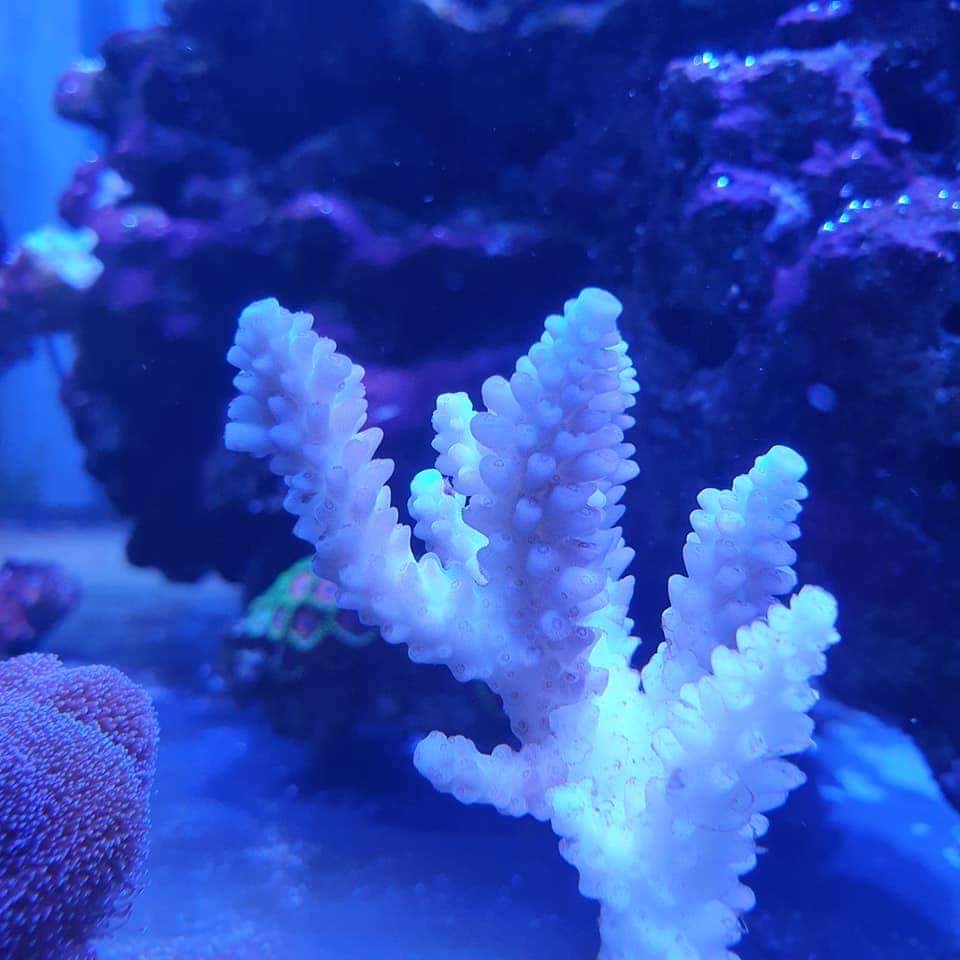
(Corals hit by bleaching; photos by Michele Menditto and Stefano Danut Hortolomei)
Prevention and remedies
Once the causes have been found, it is extremely important not to make further sudden changes. It would come naturally to want to correct alkalinity, salinity or temperature immediately, but doing so will further increase the coral's chances of dying and will probably cause further damage to other colonies in the tank. Changes must be made very slowly: one or two days to restore temperature, three or four days for salinity and a week for alkalinity.
How long to give each correction
- 1Temperature in one or two days
- 2Salinity in three or four days
- 3Alkalinity in a week
The solid colour is the minimum time, the pale one the maximum. Correcting at once raises the risk for all the colonies.
At present, if you act quickly, the only way to try to limit the damage from RTN and STN, although there is no certainty of saving the coral even partly, is to cut about two centimetres beyond the area affected by the infection; the cut must be clean, using cutters suited to the size of the branch or section to be cut. All the tools used must be cleaned and sterilised beforehand.
Where to cut an affected branch
- 1Start of the damage the area hit by the infection
- 2Margin the cut falls about two centimetres in
- 3Clean cutters suited to the branch, clean and sterile
- 4Part to save no certainty of success
A clean cut, made quickly: it gives no certainty, but for the author it is the only way to limit the damage.
Author: Massimo Ramognino
Sources
- Luna G.M., Biavasco F., Danovaro R. (2007). Bacteria associated with the rapid tissue necrosis of stony corals. Environmental Microbiology 9(7): 1851-1857.
- Verde A., Bastidas C., Croquer A. (2016). Tissue mortality by Caribbean ciliate infection and white band disease in three reef-building coral species. PeerJ 4: e2196.
- NOAA (2026). What is coral bleaching?. National Ocean Service.
- Dunn S.R., Schnitzler C.E., Weis V.M. (2007). Apoptosis and autophagy as mechanisms of dinoflagellate symbiont release during cnidarian bleaching: every which way you lose. Proceedings of the Royal Society B 274: 3079-3085.
- Leal M.C., Ferrier-Pagès C., Calado R., Thompson M.E., Frischer M.E., Nejstgaard J.C. (2014). Coral feeding on microalgae assessed with molecular trophic markers. Molecular Ecology 23(15): 3870-3876.
- NOAA (2026). What are El Niño and La Niña?. National Ocean Service.
On the same topic
Metabolism. The coral is a holobiont
Acropora are not just light-dependent: they are predators, and they are not even a single individual. Chapter 5: the…
Nutrients. Producer or consumer?
Acropora do not live on light alone: they are a cooperative between an animal and an alga. Chapter 2: why nitrogen…
The science of heterotrophic feeding in Acropora
Acropora are not just light-dependent: they are elite predators. Why light is not enough, the three ways an Acropora…