
Nuisance algae in the aquarium
What makes them grow, who eats them and eight tips to keep them in check
In general, algae (from the Latin Algae) are plant organisms with a thallus and chlorophyll that live in water. They can be autotrophic, single-celled or multicellular, but in every case they make chemical energy through photosynthesis and produce oxygen.
Algae range in size from microscopic (single-celled phytoplankton) to multicellular (kelp).


During photosynthesis algae take up ammonia, nitrates, phosphates and heavy metals; they also fix nitrogen and release organic substances useful to fish and invertebrates.
Who eats algae
They are mainly eaten by certain fish, chief among them the surgeonfish (Acanthuridae), while among invertebrates sea urchins (Mespilia globus and Diadema) and the snails known as Mexican Turbo snails are widely used.
The algae grazers in the tank
- 1Surgeonfish fish that graze algae
- 2Mespilia urchin one of the urchins mentioned
- 3Diadema urchin the other urchin mentioned
- 4Turbo snails known as Mexican Turbo snails
- 5Algae food for all of them
Fish, urchins and snails have the same job: grazing the algae.

Why they grow
The main causes behind the growth and survival of algae in our aquariums are: high amounts of nutrients, intense light, waste and excess food.
What makes algae grow
- 1Intense light one of the main causes
- 2Excess food what the fish do not finish
- 3Waste the load the fish produce
- 4Too many nutrients nitrates (NO3) and phosphates (PO4)
- 5Algae grow and survive
Light, extra food and waste become nutrients, and nutrients become algae.
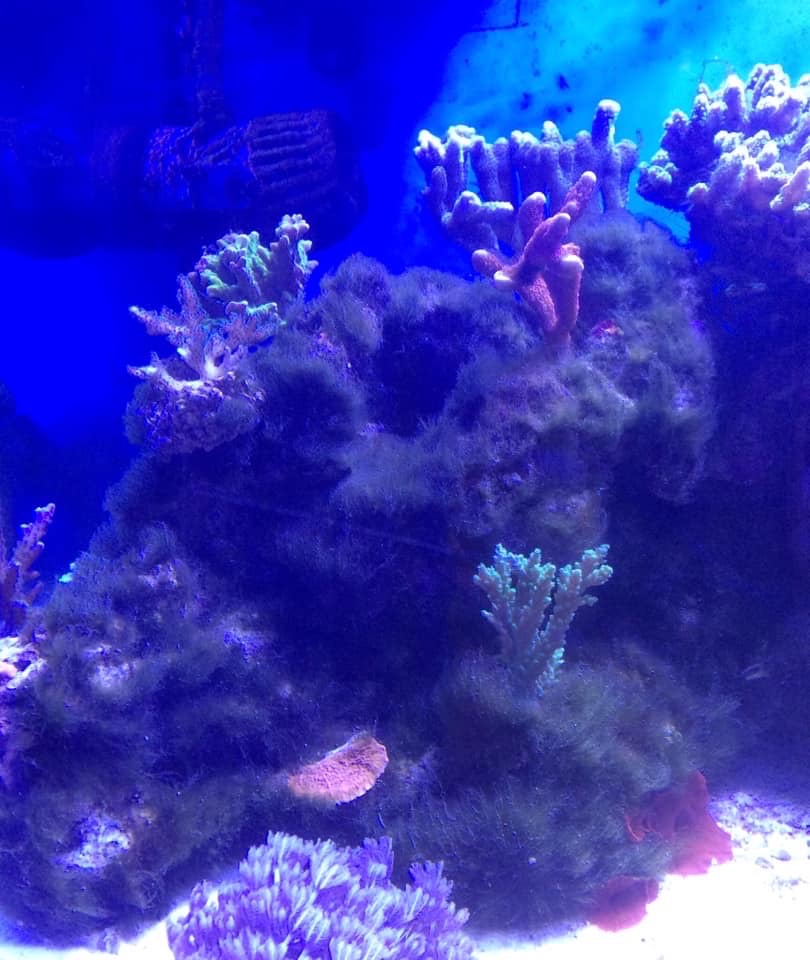
Some of the causes above come from partial water changes that are irregular or too small for the volume of water in our aquariums.
This maintenance task helps keep pH stable (in the range 8.2/8.4) and lower phosphates and nitrates, as well as the build-up of toxic substances.
Derbesia and Bryopsis
As regards the nuisance algae of the genera Derbesia and Bryopsis, I strongly recommend reading the article on using the drug fluconazole.


Salt, rocks and sand
Using top-quality sea salt mixes helps significantly in curbing algal growth. Note that the best mixes contain balanced amounts of calcium and alkalinity and are almost free of nitrates and phosphates, the main causes of algae growth.
In any case (personal opinion and conviction), live rock does an excellent job of absorbing nitrates and phosphates, while the so-called "thin layer of sand" causes build-up.
So I remain firmly convinced that an aquarium should be run Berlin-style (without sand) or with a DSB (a layer of about 11 cm of aragonite sand).
No sand, little sand, lots of sand
- 1Berlin the tank has no sand
- 2Thin sand for the author it causes build-up
- 3DSB aragonite sand layer, about 11 cm
The author's opinion: Berlin or DSB, not the halfway house of a thin sand layer.

Tips to curb nuisance algae growth in the aquarium
- Use RO water (for partial water changes and top-up), free of dissolved salts and silicates;
- fit an efficient skimmer, oversized for the tank's volume;
- add, as a precaution, about four Turbo snails for every hundred litres of tank;
- keep nitrates (NO3) and phosphates (PO4) close to zero;
- use, only in extreme cases, specific absorbers (resins) to lower phosphate levels;
- use an algae reactor to lower nitrates, or fit a refugium;
- use top-quality hyper-activated carbon;
- siphon and manually remove filamentous algae.
The remedies in their place, between tank and filter
- 1RO water for changes and top-up, no salts or silicates
- 2Skimmer efficient and oversized
- 3Turbo snails about 4 per 100 litres, as prevention
- 4Nitrates and phosphates values close to zero
- 5Phosphate resins only in extreme cases
- 6Reactor or refugium algae lower nitrates
- 7Hyper-activated carbon top quality
- 8Siphon and hands remove filamentous algae
There is no single remedy: the eight tips act at different points.


Article written by: Ciro Murino
Sources
- WoRMS Editorial Board (2026). Mespilia globulus (Linnaeus, 1758). World Register of Marine Species.
- Burkepile D.E., Hay M.E. (2006). Herbivore vs. nutrient control of marine primary producers: context-dependent effects. Ecology 87(12): 3128-3139.
- Burkepile D.E., Hay M.E. (2008). Herbivore species richness and feeding complementarity affect community structure and function on a coral reef. PNAS 105(42): 16201-16206.
- Advanced Light Source (2024). Symbiotic Nitrogen-Fixing Microbe Evolves into Organelle (on Coale et al., Science 384: 217, 2024). Lawrence Berkeley National Laboratory.
- U.S. National Library of Medicine (2018). Fluconazole: MedlinePlus Drug Information. MedlinePlus.
On the same topic
Treatment against Valonia
A spot method against Valonia and other algal infestations: hydrogen peroxide and Coral Snow applied with a pipette.…
Unwanted pest animals
Aiptasia and majano are small anemones that get into the tank on rocks and frag plugs and multiply fast. How to…
Cyanobacteria: Causes and Remedies
What cyanobacteria are, why they appear after a period of neglect, the fourteen precautions to prevent them and the…