
Euphyllia
The beginner's coral: which ones there are, how to recognise them and where to place them in the tank
In our beloved hobby of marine aquarium keeping it is also called the beginner's coral, because it is easy to manage; it is usually one of the first to go into our tanks, and it should never be missing because in my opinion it is a stunning coral.
But we must say straight away that this is not entirely true, partly because, like other corals, whether soft, LPS or SPS, Euphyllia also needs its own care.
The skeletons of these animals, if cut open, show corallites¹ and thin plates, but at the same time are very massive and tough. In fact they are called LPS stony corals, or stone coral.
The varieties.
Euphyllia are also chosen for the variety available, both in colours and in types; here are the ones I know.
Ancora and Parancora.
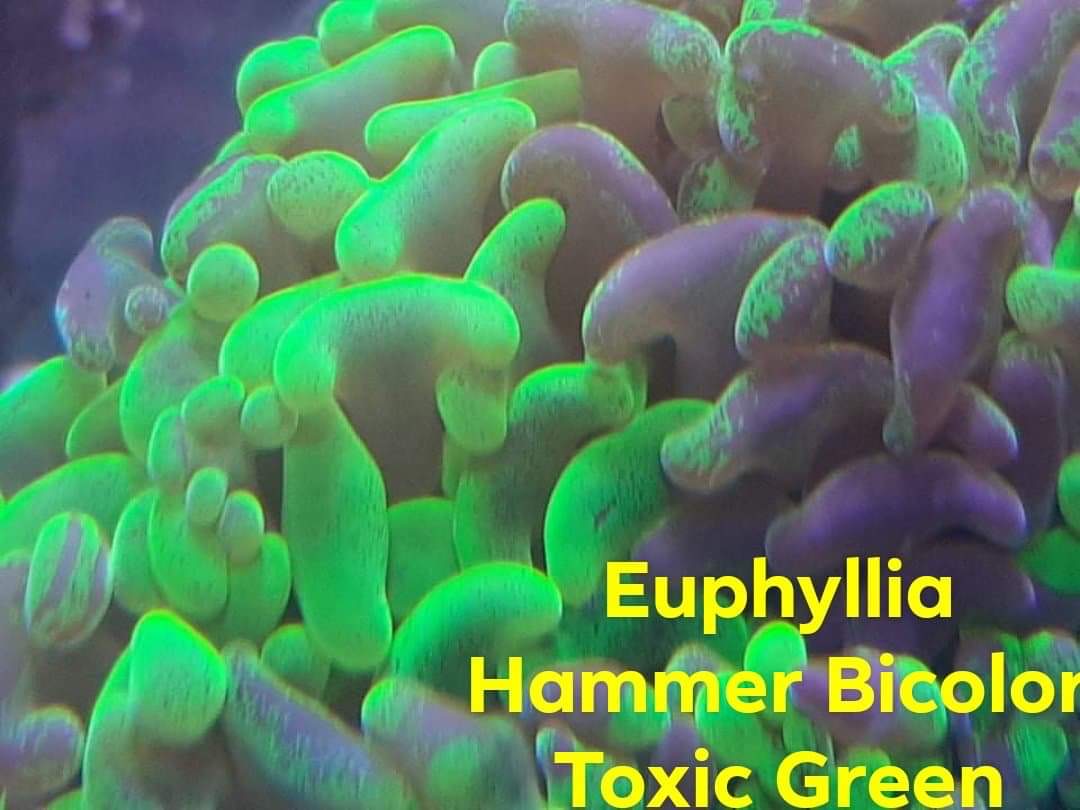
Euphyllia Ancora and Euphyllia Parancora, also called Hammer (for their hammer or anchor shape): between Ancora and Parancora there is a difference due to how the skeleton develops, and they have a specific name you will find further down.
Euphyllia Ancora has a single skeleton, whereas Euphyllia Parancora has a skeleton that develops in calices.


Glabrescens.
Euphyllia Glabrescens or Torch Coral, because of its long, thread-like tentacles with a movement described as "flame or torch-like" and tips of a different colour; these too come in a great variety of colours, and the skeleton is in calices.
Euphyllia glabrescens has medium-sized polyps and tentacles similar to those of anemones, which is also why our clownfish friends often form a symbiosis with them. Most polyps are brown or green, but they can also be blue or reddish, with iridescent tips.

Its "sweeper" tentacles are thinner in diameter than the normal ones, and it can extend them up to 15/20 centimetres long, reaching and "stinging" nearby animals.
Needless to say, this applies to all Euphyllia.
Sweeper tentacles reach a long way
- 1Euphyllia glabrescens medium-sized polyps, like anemones
- 2"Sweeper" tentacles thinner than the others, up to 15/20 cm
- 3The stung neighbour animals too close get hit
- 4Out of reach leave space: true of all Euphyllia
When you put it in the tank, leave space around it: the longest tentacles can sting nearby animals.
Sources: [6]
Paradivisa and Divisa.
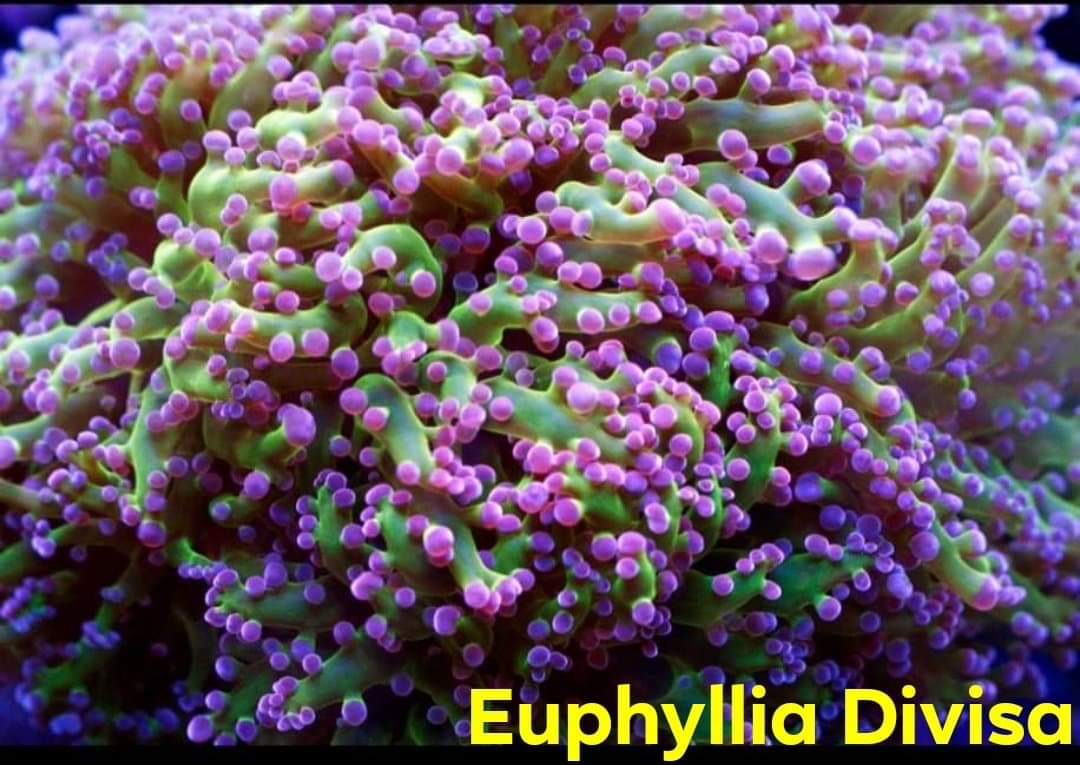
Euphyllia Paradivisa. The colonies are often large. The polyps are long and floating, flesh-coloured or green with white, green, purple or pink tips; generally they are fully extended during the day and partly at night.
It is often confused with Euphyllia Divisa. The subtle difference between the two species lies in the coral's morphology: Euphyllia divisa has corallites¹ described as phaceloid² (corallites close together, but not touching).
Euphyllia Paradivisa has a branching skeleton with flabello-meandroid³ corallites¹ (that is, with the corallites joined but distinct) (in calices); the natural habitat of Euphyllia Paradivisa is the shallow part of the reef, so it can be placed high up. But be careful: since it grows well, it could take light away from animals placed below it.
Euphyllia Divisa, like Paradivisa, is a touch delicate to manage, so it is not suitable for beginners.
I have named them last because, unlike the others, they need a bit more experience to keep; feeding these corals weekly or more often can greatly encourage their growth in the aquarium.
If the light is good and favourable and the flow pumps are aimed properly, polyp expansion and growth will be encouraged, and it can generally reach and exceed thirty centimetres in diameter.
You recognise them by the tree-like branching of the soft tissue, with button-shaped tips that are always a different colour from the tentacle; to understand the difference between Euphyllia Divisa and Paradivisa, and tell them apart, you have to look at the skeleton: being almost identical in shape, it takes an expert, well-trained eye.

Three tentacle shapes
- 1Ancora and Parancora called Hammer: hammer or anchor shape
- 2Glabrescens or Torch Coral long, thread-like, move "like a flame"
- 3Divisa and Paradivisa tree-like branching, button tips
The tentacles tell you the type, but to tell Divisa from Paradivisa you have to look at the skeleton.
Sources: [1]
- ¹ corallites: means stone coral, in practice the hard skeleton.
- ² phaceloid: corallites close together, but not touching (calices). Group 1.
- ³ flabello-meandroid: corallites joined but distinct. Group 2.
Euphyllia fall into 2 groups.
Group 1 includes the species Euphyllia Glabrescens, Euphyllia Yaeyamensis, Euphyllia Cristata, Euphyllia Divisa and Euphyllia Parancora.
Group 2 includes the species Euphyllia Ancora and Euphyllia Paradivisa.
The two groups of Euphyllia
- 1Phaceloid close but not touching: Glabrescens, Yaeyamensis, Cristata, Divisa, Parancora
- 2Flabello-meandroid joined but distinct: Ancora, Paradivisa
- 3Plates thin but massive and tough
The groups are as given by the author: for Divisa and Paradivisa see the note below.
Sources: [1]
Placement and feeding.
They are best placed in the middle to lower area, with indirect, moderate flow and adequate but not strong light: we leave full light to more demanding animals.
Middle to lower area, little direct flow
- 1Adequate, not strong light full light is for more demanding animals
- 2Middle to lower area is the recommended placement
- 3Moderate flow indirect: helps the polyps extend
- 4More demanding animals these do go in full light
Flow is very important, but it must arrive moderate and not straight at them.
Flow is very important for their extension, and so for the animal's health; too much flow can make the tissue fold over and touch the plated skeleton, injuring the animal, leading it to close up and to tissue necrosis, creating brown gelatinous strands called "Brown Jelly". Once it has reached this condition the animal dies; the only thing you can try is to cut away the dead part and hope.....
From folded tissue to Brown Jelly
- 1Polyps extended the right flow is good for health
- 2Excessive flow the tissue folds over
- 3The injury tissue touches the plates: closing and necrosis
- 4Brown Jelly brown gelatinous strands
This is the author's account; one study links Brown Jelly to a ciliate: see the box.
Sources: [5]
Euphyllia get their food mainly through photosynthesis, carried out by the zooxanthellae that live in symbiosis inside them; they also feed on microorganisms in the water and, being sweepers, they do not turn down powders or foods meant for other corals, such as SPS or LPS foods.
Values in the aquarium.
Euphyllia in general, although considered hardy, do not like sudden swings in KH and pH at all.... high PO4 and NO3... or temperatures that are too high, above 26°
Ideal parameters:
- temperature between 23°/26°
- salinity 1023/1025
- KH between 7/10
- Ca 420/450
- Mg 1280/1350
- pH between 8.1/8.4
- PO4 0.01/0.03
- NO3 between 1/3 (Nyos test)
I hope I have been of help, especially to the group's beginners who would like to add this beautiful coral. A warm hug and happy reefing to all.
Article written by: Angelo Dell'Orso
Sources
- Luzon K.S., Lin M.-F., Ablan Lagman M.C.A., Licuanan W.R.Y., Chen C.A. (2017). Resurrecting a subgenus to genus: molecular phylogeny of Euphyllia and Fimbriaphyllia (order Scleractinia; family Euphyllidae; clade V). PeerJ 5: e4074.
- WoRMS Editorial Board (2026). Fimbriaphyllia ancora. World Register of Marine Species.
- Ben-Zvi O., Eyal G., Loya Y. (2019). Response of fluorescence morphs of the mesophotic coral Euphyllia paradivisa to ultra-violet radiation. Scientific Reports 9: 5245.
- Coral Disease & Health Consortium (2026). Coral Anatomy and Histopathology Terms. National Oceanic and Atmospheric Administration.
- Sweet M., Craggs J., Robson J., Bythell J. (2013). Assessment of the microbial communities associated with white syndrome and brown jelly syndrome in aquarium corals. Journal of Zoo and Aquarium Research 1(1).
- NOAA National Ocean Service (2026). Corals Tutorial: What are corals?. National Oceanic and Atmospheric Administration.
- NOAA National Ocean Service (2026). Corals Tutorial: What is Zooxanthellae?. National Oceanic and Atmospheric Administration.
On the same topic
Metabolism. The coral is a holobiont
Acropora are not just light-dependent: they are predators, and they are not even a single individual. Chapter 5: the…
Nutrients. Producer or consumer?
Acropora do not live on light alone: they are a cooperative between an animal and an alga. Chapter 2: why nitrogen…
The science of heterotrophic feeding in Acropora
Acropora are not just light-dependent: they are elite predators. Why light is not enough, the three ways an Acropora…
Comments (1, in Italian)
scheda molto Eusastiva complimenti Angelo